The Drunken Bicycle
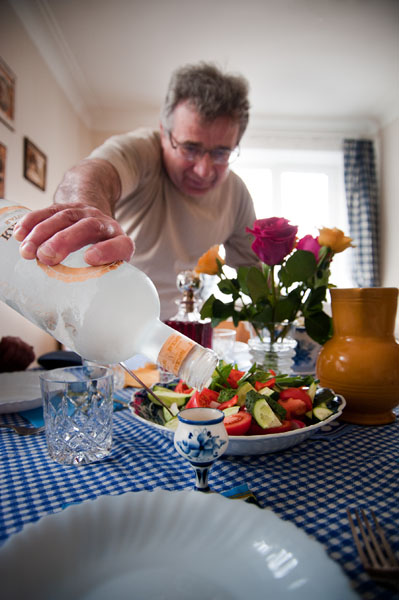
Preparation for the toast, Siberia, 2010, all photos Frank Ward
My portfolio of travels in the Former Soviet Union from 2005 to 2010 has just opened at the Photo Eye Gallery and at SocialDocumentary.net
Some of the pictures in this post aren’t actually in either show. These first five didn’t make the final cut, but I like them anyway.
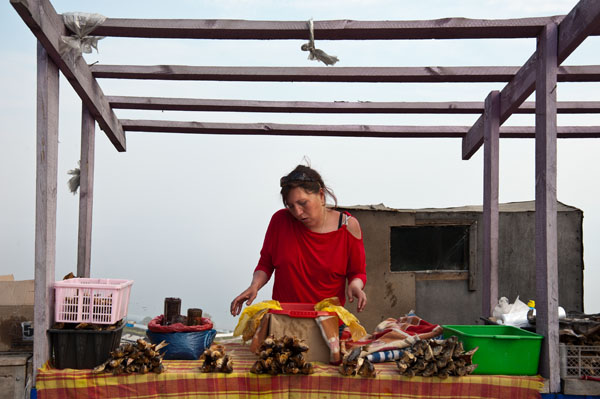
Fishmonger, Lake Baikal, 2010
The following statement from The Drunken Bicycle on Photo Eye is interspersed with my comments in parenthesis.
Occasionally, in the town squares of many cities in Siberia there is a man selling rides on a bicycle, a drunken bicycle. A conventional two-wheeled bike has been outfitted with a reverse steering gear. If one turns the handlebars right, the front wheel turns left. Of course, the operator demonstrates how easy it is to ride and offers bottles of beer if one can simply travel a few meters without falling. Crowds circle the action, and there is never a shortage of brave young men who attempt the traverse. That said, I have not yet seen a customer navigate the bike successfully.
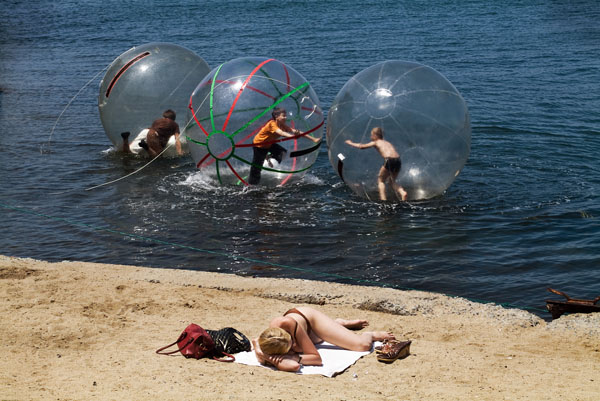
Beach Bubbles, Vladivostok, 2008
The drunken bicycle is an apt metaphor for life in the Former Soviet Union (FSU). The bureaucrats appear to be swaying on a drunken bicycle; the hapless traveler spends his days confused by the swing of it, and this photographer is continually under its influence.
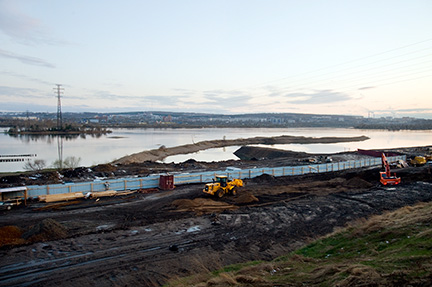
"I love you, I love you," the armed guard said as he threatened me, Siberia, 2010
My confounded expectations while photographing can be accompanied by some curious pleasures. The security guard repeating, “I love you, I love you,” as he gestures for me to delete my pictures of a waterfront habitat destroyed by land moving equipment. Or the policemen who accused me of stealing strategic military secrets because I was photographing a World War II tank cemented into a pedestal in a city park.
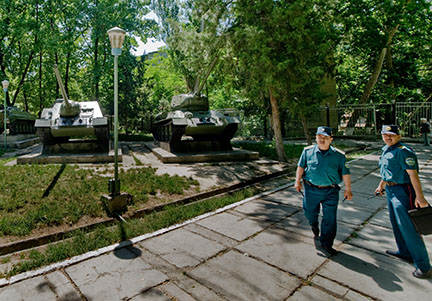
Caught photographing military secrets, 2009
Or the graffiti scribbled in large block letters on a desk in a high school hallway: “Stalin is gay.”
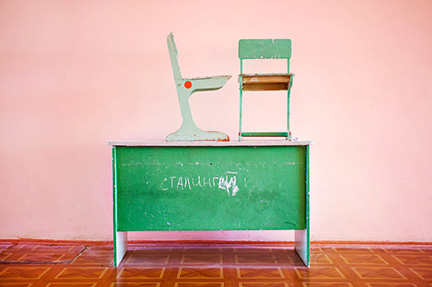
Desk and chairs, Elista, Russia, 2009
It is difficult not to telegraph my bemusement of these incidences with my smile. The publicly dour Russians think we Americans have a foolish grin continually pasted on our faces. Well, I do, but it is not the former Soviets I am laughing at. It is the joy of seeing Marilyn Monroe represented in a wall-sized painting with Lenin looking up at her,
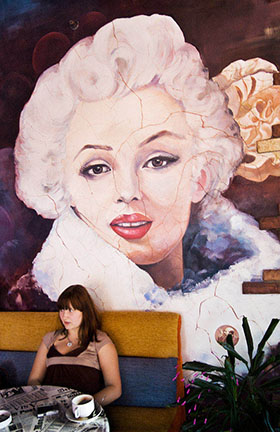
Marilyn Monroe lovingly observed by Lenin, Vladivostok, 2008
or my surprise at a grandmother who asks me to take her picture in a bikini at the beach. The FSU is a paradise of paradox, where the landscapes are limitless and the people are full of passion and pain.
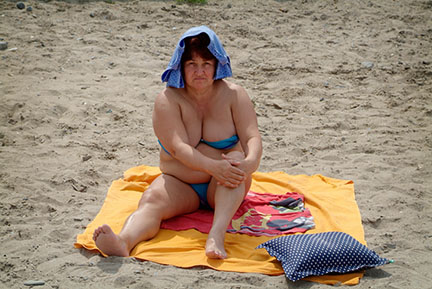
Babushka in a bikini, Odessa, 2005
The closing picture, illustrating an ancient mosque in Khiva, is actually a photograph of a soccer game where all but one of the participants have blurred into invisibility during the long night exposure.
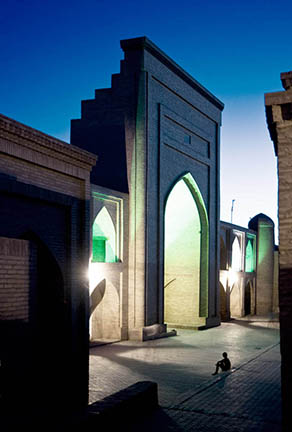
Night soccer in front of a mosque in Khiva, Uzbekistan, 2010
The exhibit on SocialDocumentary.net is called The Great Game after the 19th century conflict between Russia and Britain over domination in Central Asia. I haven’t included any pictures from SDN in this post. Please take a look if you want to see more.
Ossabaw Island
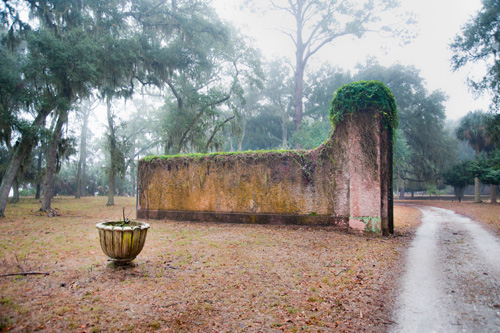
Gateway, Ossabaw Island, Georgia, 2011, All photos by Frank Ward.
I don’t know what to say about Ossabaw. It is a magical Georgia Sea Island where HCC professor Justin West grew up. For many decades it was an artist’s retreat where writers, painters and photographers, such as Sally Mann, went for inspiration. In fact, Sally photographed the Main House Gate several years ago. I tried to find the picture online just to make sure my version (above) wasn’t too derivative. Somebody let me know if you find a link to it.

View from the front of the Main House.
I willingly fell into photographing the mind-easing beauty of the island.
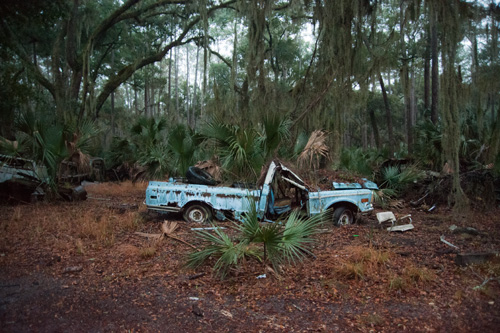
The Ossabaw dump
Fortunately, the first place that Justin brought me when he and his wife, Eileen, picked me up at the dock was the dump. He knows what I like.
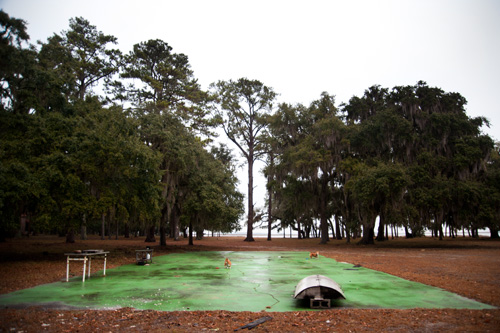
Outdoor kitchen
At the Main House, I only had to walk around the grounds to find lots of “my kind of” pictures. Some may remember a picture I took similar to the “Outdoor kitchen” last year in Siberia. For some reason I am not attracted to the abundant greens of nature, but I am fascinated with man-made greens.
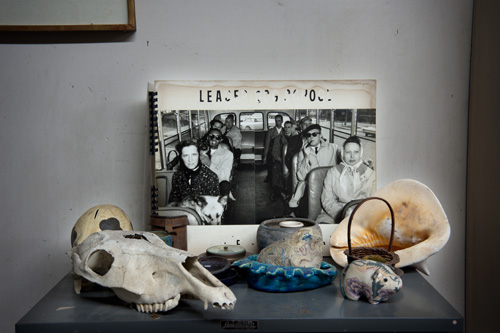
A photography book by Justin West
I was poking around one of the many studios in the Main House and found this still life. The photo reminded me of pictures by Robert Frank from his The Americans. It turned out to be a book by Justin that he made in a high school photography class. It is called Leader Dog School and is about training seeing-eye dogs. The pictures inside are wonderful and remind me of contemporary German photography by students of the Dusseldorf School.

Lula Belle in the entry hall
HCC professor Robert Aller has also spent time at Ossabaw. We had a conversation about the ghosts of the island. In the 1800s, Ossabaw was the location of three plantations and over 2000 slaves. Inherent in the Gothic beauty of the “old” South is the pain and presence of the ‘haints’ of history. The “haints’ are the apparitions and emanations of those who have come before. As a reminder of their presence, Lula Belle, a wax figure with human hair, greeted arrivals at the Main House.
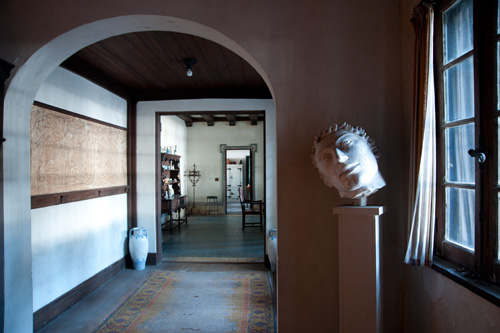
Main House hallway
There are 3 or 4 long hallways that lead off the entry room. Opposite Lula Belle, the above hall leads to the dining room and kitchen. The Main House is a treasure with 15 bedrooms and even more bathrooms (all with elaborate wicker chair toilet seats).
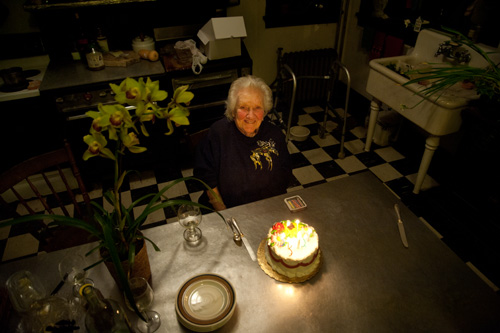
Moose has been a presence at Ossabaw since 1924
I arrived on the birthday of Justin’s 98 year old mother. I saw the house as a living museum and Justin’s mom, Moose, as the curator, director and resident spiritual adviser. Not only does she live in paradise, she has “paradise inside of her,” according to a checkout lady at Kroger’s Supermarket on the Mainland. Sitting and talking with Moose is a life affirming encounter of the best kind.
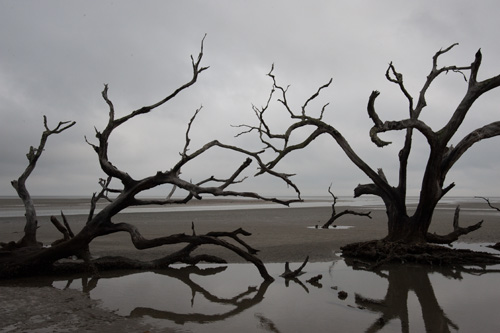
South End Beach
Moose lives alone on Ossabaw. There are two other residents that live 10-15 miles away on the other side of the island. The distance in between is comprised of dirt tracks with names like Hell Hole Road and Mule Run.
Ossabaw has lots of wildlife including six wild donkeys, wild hogs, horses, a goose, seals, deer and alligators. We saw a six footer on the causeway after Justin assured me that they were all hibernating.
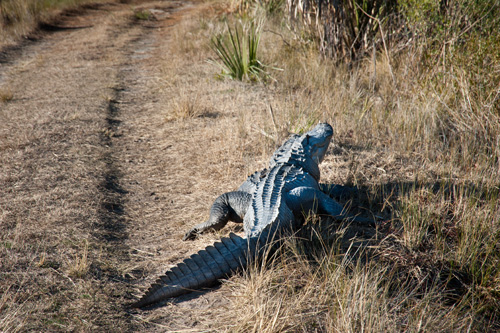
Not a great picture, but I did not want to ask it to turn around
Luckily, we did not see any snakes although Ossabaw has every kind of poisonous snake known to North America. Did I call this place paradise? Well, even Adam and Eve’s paradise had a snake.
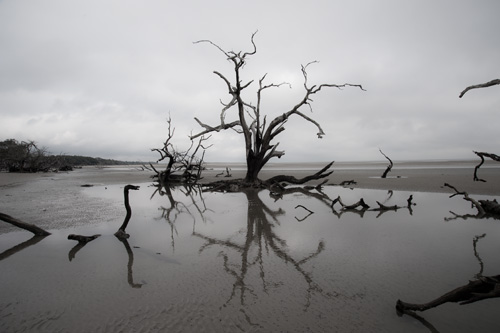
On the beach
I traveled to the Island with Porgy and Bess. Here they are enjoying nature.
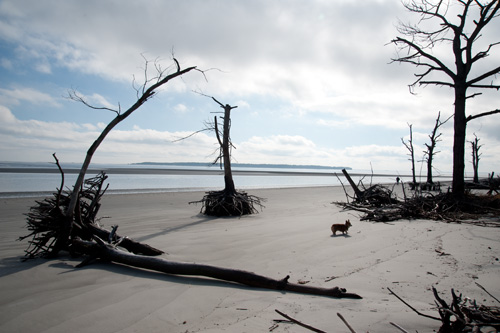
Bess on the beach
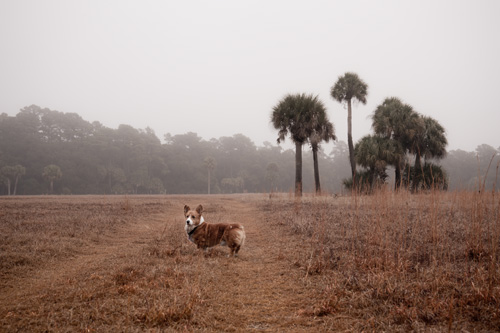
Porgy at Middle Place
Access to Ossabaw is by invitation only. It is mostly owned by Georgia. Moose sold it to them back when Jimmy Carter was governor. Incidentally, I slept in Jimmy Carter’s bedroom. I would have rather slept in Margaret Atwood’s, Annie Dillard’s, Ralph Ellison’s or Aaron Copland’s room. Maybe they all slept in the Jimmy Carter bedroom.
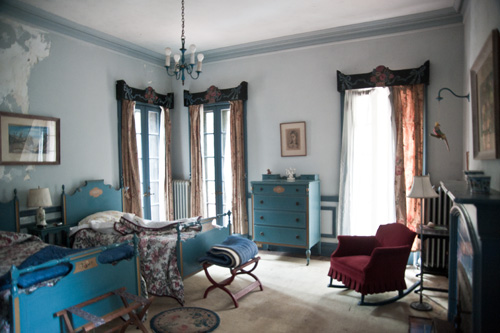
The Jimmy Carter Bedroom
Thanks to Justin, Eileen and Moose for inviting me. I’ll end with a couple of more views of the Atlantic.
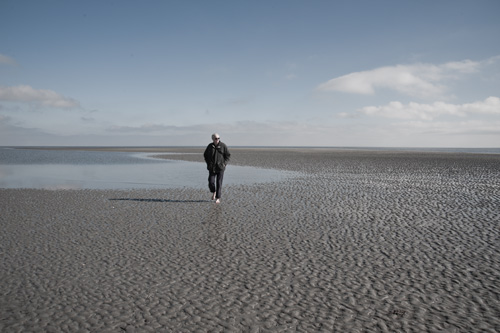
Justin at the beach
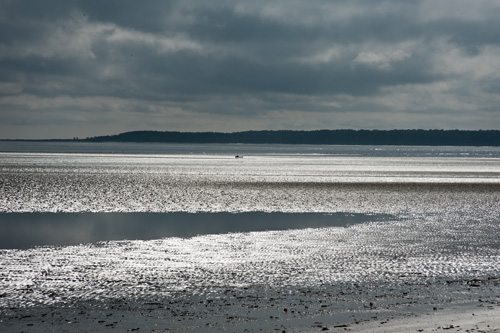
Coastal view
Lost in Siberia Exhibition and Booksigning

View from the train, 2005, by Frank Ward
There will be a reading by Vivian Leskes and a book signing by both of us at the closing reception of our Lost in Siberia photography show at the Taber Gallery at Holyoke Community College this Wednesday, Jan. 26th, 2011. The party is from 11:00 to 12:30 with the reading at 11:30.
To get to HCC, take Interstate 91 toward Holyoke and get off at Route 202 West. Follow 202W for less than a mile and HCC will be on your right. Follow the ring road around until you see Visitor’s Parking, at the top of the hill and near the small traffic circle at the main entrance. Go down the exterior steps of the main entry and the Taber Gallery is in Donahue Building on your right before the bottom of the staircase. The Taber Gallery is accessed through the Library immediately to your right upon entering Donahue.

Sailor on the Sea of Japan, Russian Far East, 2008
Hope to see you there.
Student work that works

Emily Yousfi and her Holga
It has been awhile since I last posted. Mostly, that’s because I’ve been involved in finishing off the semester, finishing a book, walking the dogs and generally feeling too mellow to post.
I thought I’d exhibit some of the work my Holyoke Community College students have created this past fall. Above is a double exposure using a plastic camera by Emily Yousfi. She was in both my Photojournalism and my Digital Fine Art classes. She mostly shot film and did not use Photoshop to manipulate her results. Nor did she let the concept of Photojournalism limit her ability to make pictures stemming from her personal vision.
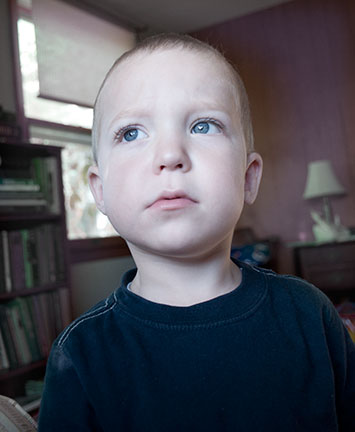
Portrait by Jessica Smart
Digital Fine Art student Jessica Smart brings us from the joy of plastic to the pleasures of point-and-shoot. Her pictures are about the ongoing moment.

From the Big E by Manda Robillard
Photojournalism and Digital Fine Art student Manda Robillard created an “old school” photojournalists image. It almost makes me want a Bud.
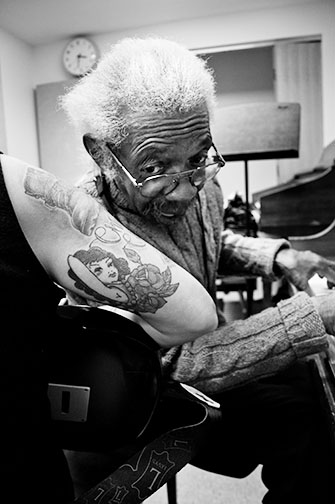
Musicians by Roberto Deza
Rob Deza offers a very interesting example of the arc of an art student. Last spring he couldn’t make a successful picture for Advanced Photo. I knew he was a good photographer from his previous work in my Inside Post-Industrial Holyoke class, so I waited him out. This fall he was in Digital Fine Art and made a creative breakthrough that may lead to a successful career in photo and video. He was enlisted by National Geographics to work with them in Holyoke and he got a tempting job offer from a studio in LA, CA stemming from his fashion and glamor photography.

Kristin Hanley photo
After the roar of the classroom has subsided and the grading is completed, which pictures do I go back to just because I like them? Kristin Hanley was my Digital Fine Art hipster. She photographed her friends with generous cooperation from the photo gods. She photographed them simply hanging out, and simply partying their booties off.
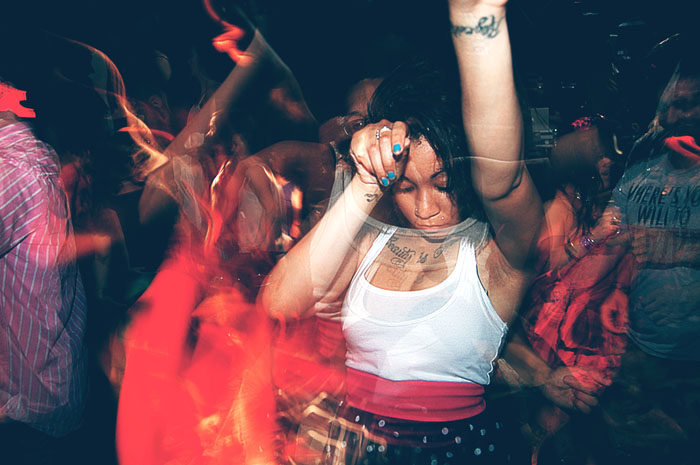
Partying with Kristin Hanley
None of the above pictures are by my Basic Photo students. They worked in film which did not get transferred to my computer. Below is one picture of Basic student Digno Ortiz that I made in the studio. He is a boxer and offered to spar with our model, who also boxes. The students made many wonderful b/w film pictures during this studio session. This is just one that I happened to make on my DSLR.
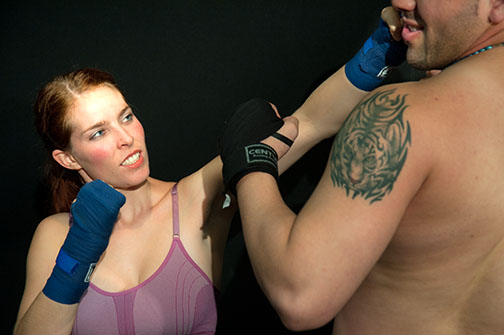
Thea and Digno duke it out
Ingrid Bergman stole the highlights
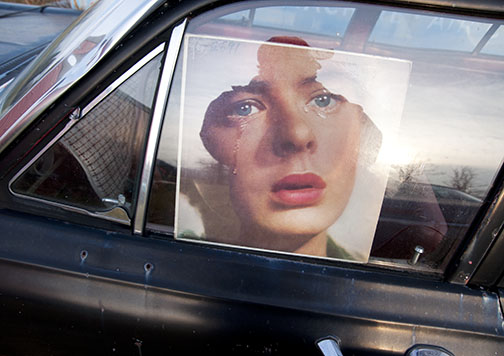
1. Ingrid Bergman in her Chevy Nova
I was thinking of angels and devils this week and conjured up my favorite angel, Ingrid Bergman. She died in 1982 but arrived on Monday in her vintage 70s Nova. She came to help me prepare an entry for the 6th Annual Jane Lund Invitational at the Northampton Center for the Arts. This year’s theme is Angels and Devils.
Ingrid and I went to Mister Tire in Plainfield. In the following picture Ingrid shows me her first choice in tires.

2. Ingrid at Mister Tire
When we got back home, Ingrid helped me with Thanksgiving cleaning. I have pictures of her with the dishes, sweeping the floor, making coffee, cleaning the refrigerator, sitting in the oven, etc. My favorite picture is of her helping me with the ironing.
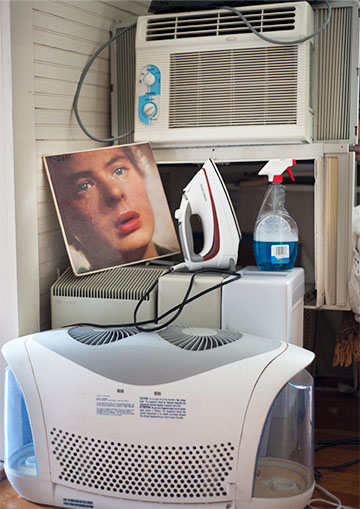
3. Ingrid and the iron
I’m noticing how aerodynamic all my appliances are. They would have very litle wind resistance if I threw them out the window. Anyway, after Ingrid and I finished our work we settled down for some quality time.
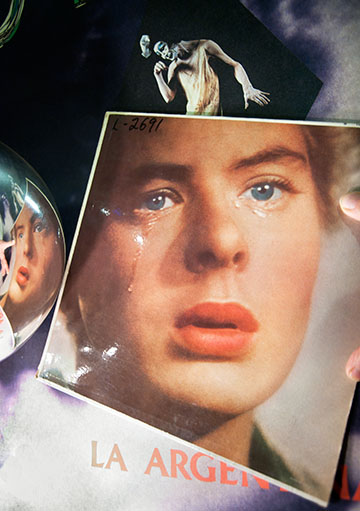
4. Ingrid meets the late butoh master Kazuo Ohno
You may have noticed that Ingrid has been crying throughout her visit. She is represented by a record album cover for the soundtrack to “For Whom the Bell Tolls.” Ingrid earned three Oscars during her career in film. She also gave birth to Isabella Rossellini. Isabella is best known for her role in David Lynch’s Blue Velvet in the ’80s.
OK, the point to this post is that I want help deciding which print of Ingrid to submit to the Angels and Devils Invitational. I need to decide by Saturday, December 4th. Let me know which picture you like best. All suggestions will be entered into a final drawing on December 6th and the winner will receive an 8.5X11 Epson Exhibition Fiber print of their choice from the series. Please submit the number of the image you like best in a comment to this blog or via Facebook.
Holyoke Window Watching

The view through a 4th floor screen.
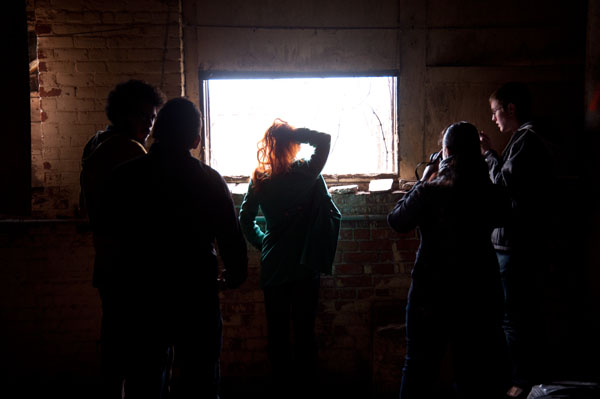
The class at work in Quantum.
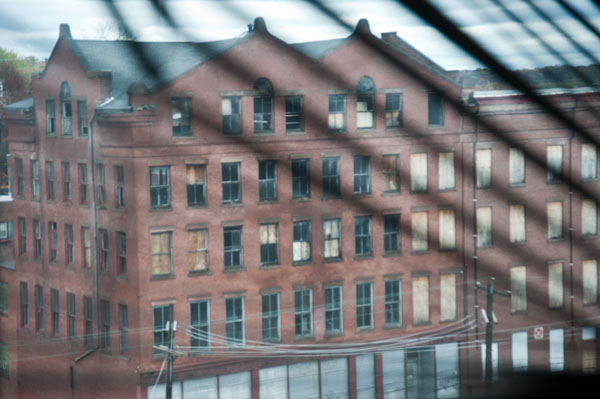
Blinds on the 4th floor
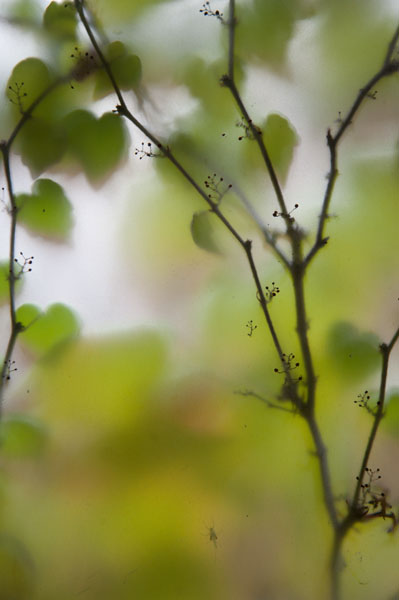
Window pane nature triumph

Ballet peeping
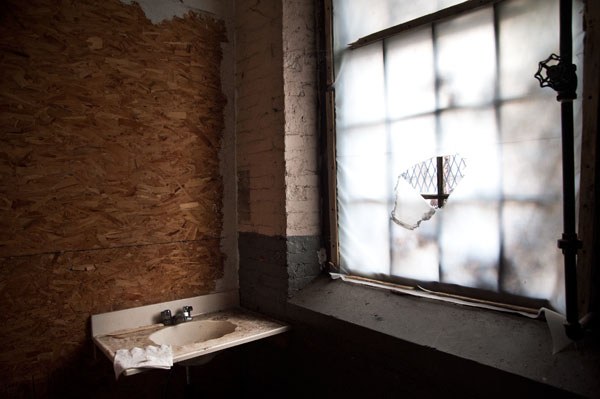
The once and future bathroom
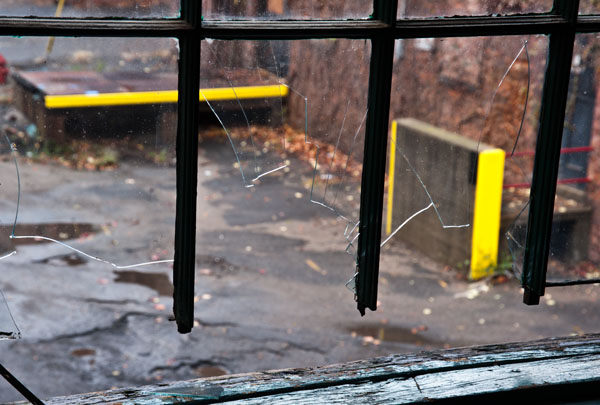
View of art and design
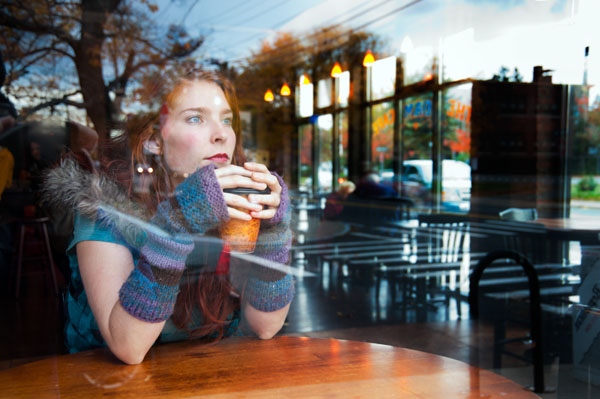
Window of the Dam Cafe
My class finished up The Holyoke Files assignment. These are my pictures, but my student’s pictures are better. I’ll post them after our crit next Friday.
I’ve cut back on the text this week because I know my students don’t read it.
The appropriate behavior of Thomas Ruff
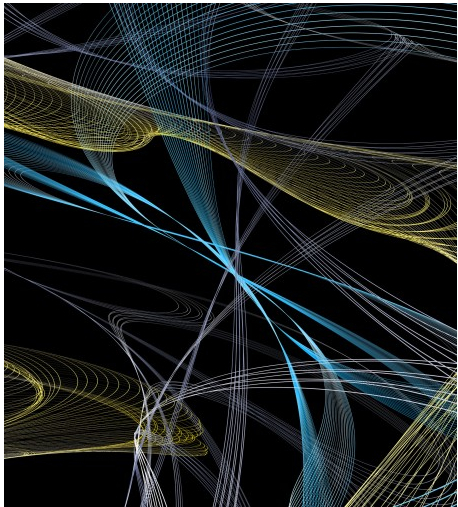
zycles 4065, 2009, by Thomas Ruff
I’ve been thinking about how the various 20th century picture making genres have been re-imagined by current artists. There are a few perky Germans who are doing a particularly energetic job of this. I’m thinking of Thomas Ruff (b.1958). In college, Ruff began with architectural interior views and graduated with portraits. He went to the head of his Dusseldorf class, taught by Hilla and Bernd Becher. I never got a chance to hear the two legendary teachers speak. I wonder if they really intended to spawn such a feverish troop of imitators? Anyway, Ruff has expanded the typological architectural intentions of his teachers to include landscapes, still life, figure, abstract, micro and macro photography and various conceptual works. Ruff has done it all. He has generated much of this large volume of art by appropriating existing imagery. Appropriation is the art of taking a previously created image and making it your own. It used to be called plagiarism. At some point in history, maybe beginning with Warhol‘s love of Cambell’s soup, artists took possession of readily available images for “art’s” sake. The legalities of such behavior remain mired in uncertainty. The above picture is a computer generated rendering of a mathematical curve. You may see a similar depiction on your own computer, they are called screen savers. Ruff ups the beauty quotient by printing them absolutely huge and in saturated colors. Actually, that is the formula for almost all his art. His favorite picture source is the internet and working with images ranging from NASA space pictures to porn, he has been gleefully copying and tweaking internet content for years.
Jpeg by Thomas Ruff
My graduate school mentor, Ben Lifson, exhibited his internet porn collages to little fanfare in Hartford a few years ago. I could only conclude that he didn’t print them big enough. I recall them as being quite saturated.
Holyoke Rising

Found Lotus, Holyoke, 2010
My Photojournalism class has started going into reclaimed Holyoke to see what gems lie in the newly kindled city.
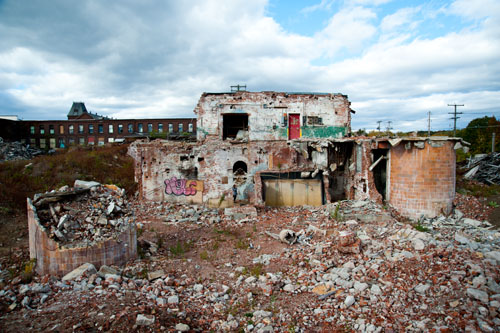
Deconstructing Holyoke, 2010
On Friday we fieldtripped down to Quantum on the lower canal where there are 16 acres of factories that are evolving and devolving daily.

Re-imagining Holyoke, 2010
The class explores in small groups like visual anthropologists watching history dissolve. And like archeologists, we move slowly, sector by sector through the newly exposed landscape.
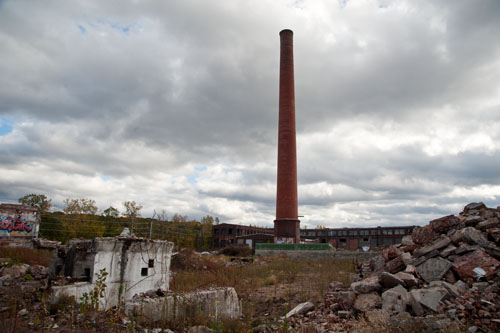
Lowlands, Holyoke, 2010
This is a landscape ripe for re-invention.

Post-Industrial Holyoke, 2010
I don’t want you to think that Holyoke is all about “ruin porn.” Last night I was walking from gallery to gallery for the four art openings that were happening. At one point I heard a girl walking with a small group saying, “I feel like I’m Batman cruising through Gotham City at midnight.”

Reconstructing Holyoke, 2010
This picture was taken at the entrance to Gallery 380R. As I exposed the photograph, a woman leaning next to me said, “if you think this is beautiful, go down to the bridge on the next block and photograph the lights from there.”
The transfiguration of urban Holyoke echoes my experience picturing the cities of the Former Soviet Union. The scars of post-industrial disillusionment are apparent, but huddled throughout the previously abandoned landscapes are enclaves of energy and possibility.

Holyoke Street School, 2010
The old Street School seems to be my landmark of choice when I am photographing downtown. Too bad it is all chopped up inside with many small, convoluted spaces. Right now my classes are photographing outdoors. As the winter comes along we will be looking for a few warm rooms. Otherwise, our fieldtrip theme will be- Have space heater, will travel.
Vision and Veracity

The Big E (detail) by Lindsay Gallant
My Photojournalism students are showing me their Eastern States Exposition photos. I am seeing a trend away from the veracity of the document and a move toward docu-art. Docu-art is a term Bill Burke coined when describing his photographs from Vietnam and elsewhere. The term is an admission of the fact that the photographer creates the picture. The subject of a photograph is only a stand in for what the photographer is really considering. In Bill Burke’s case, he has shown interest in opium dens and prostitutes, as well as the whole American legacy in Vietnam. Or is that America’s legacy in Vietnam?
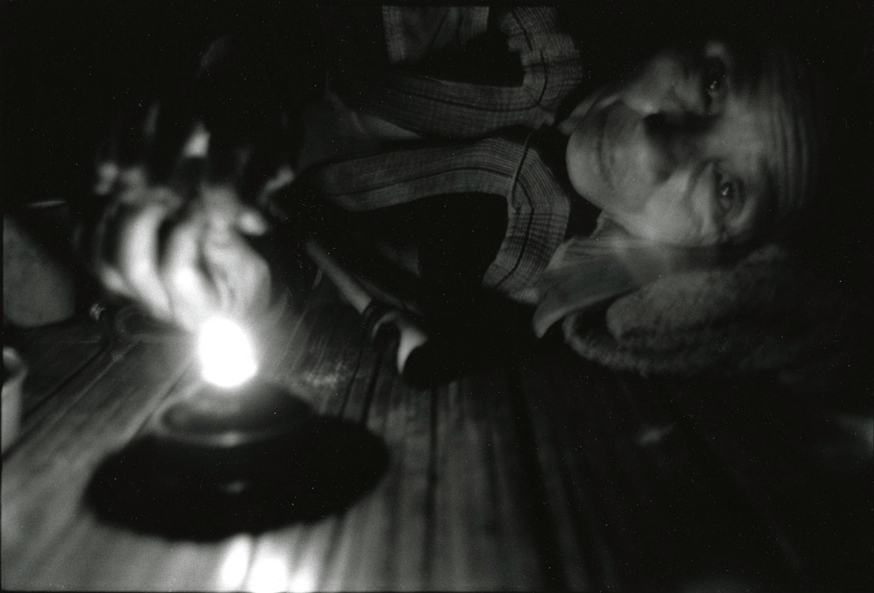
Opium Den, by Bill Burke
The expanding self-awareness of the current documentary agenda isn’t just about what the photographer sees. It is also about what the photographer knows.
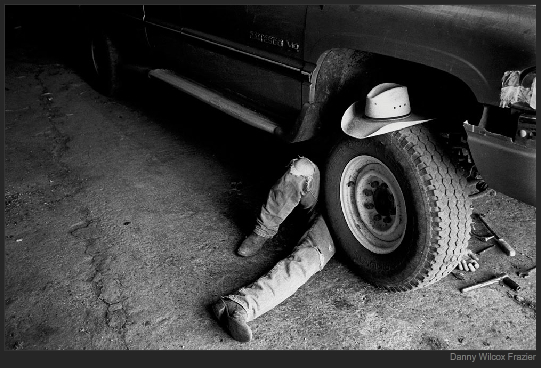
Photo by Danny Wilcox Frazier
I found the above picture on the recent NYT Lens Blog about a group of documentary artists who are emulating the work of the Farm Security Administration of the 1930s. The group is called Facing Change and you can see more of their “old style” documentary work here.
There is new work from Gregory Crewdson that appears to go in the opposite direction from his old work. Below is an example from his previous visions. I chose this because it is a pleasure to see a guy wandering around in his underwear instead of the usual skinny model. (CORRECTION: Oops! My wife, Vivian, pointed out that it is a picture of a model wandering around in her underwear, or maybe it is a guy wearing a bra. I’m hoping that is the case.)

Picture by Gregory Crewdson
“Often criticized as a pseudo-filmmaker for his ostentatious photo productions, gargantuan crews, and carefully fabricated scenes of human drama, Crewdson deliberately uses his craft to blur the lines between fact and fantasy.” That’s a quote from Vanity Fair.
So, while my students are practicing the new vision of photojournalism with plastic cameras, panoramas and double exposures, Gregory Crewdson is going in the opposite direction.His new series cites an older documentary veracity. Coincidentally, it is his first experience using a digital camera.

Cinecitta Studio, Rome, by Gregory Crewdson
To quote Crewdson, “Black and white was essential to these photographs because I wanted to reference the great classical tradition of documentary photographers like Eugène Atget and Walker Evans. The other, almost paradoxical thing is that the sets look much more staged and more fake in color. Weirdly, the black and white makes them feel more real, as if they’re real ruins.” It is also curious that he describes his prints as small, only 24X30 inches.
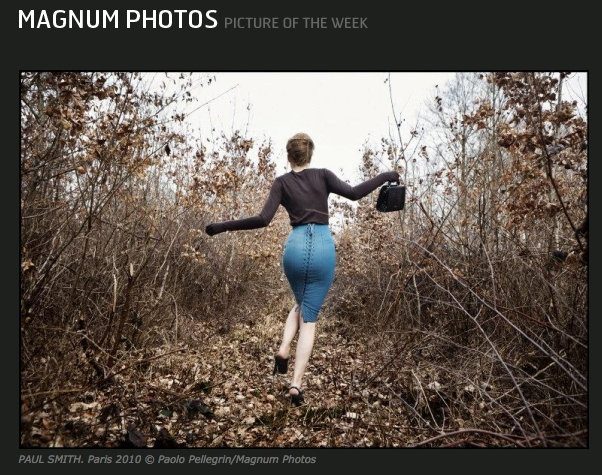
Photo by Paulo Pellegrin, Magnum
I’m attracted to the above fashion photo from Magnum. It has a “look” that seems beyond time. For me it is a vision free of veracity. As usual, the model is required to perform some act which would be highly unlikely in the real world. In this case she is prancing through the brush in high heels. I guess that is better than her trying to run away with her skirt half buttoned.
Education Expectation

University Lounge, Uzbekistan, 2010
When I’m teaching photography, the line between a “good” picture and a “not-so-good” photograph is clear to me, but I begin to wonder when comparing what curators see as “good,” I don’t think I’ve become Mr. Jones, as in Dylan’s, “You know something is happening, but you don’t know what it is…” I just feel that the world of contemporary art is on shaky ground.
I’ve been looking at mediocre imagery throughout the photography blog world these past couple of weeks. It has discouraged me from even posting. The final blow was struck by Blind Spot, that great little magazine that usually maintains the delicate balance of art and sanity by walking a ledge atop some building in New York City. Their latest issue is a real snore. And I hate to bring up the New Photography 2010 show at the Museum of Modern Art. I’m not going to post any of those pictures. They aren’t all bad, I just don’t want to get bent about the work having not actually seen it hanging on the Museum’s walls.

Chalkboard, University, Uzbekistan, 2010
I’m posting a few pictures I made this past summer in Uzbekistan. They’re about education, although, I’m still figuring out what I am learning from them.

Faculty office door, Uzbekistan, 2010

Classroom door, Uzbekistan, 2010
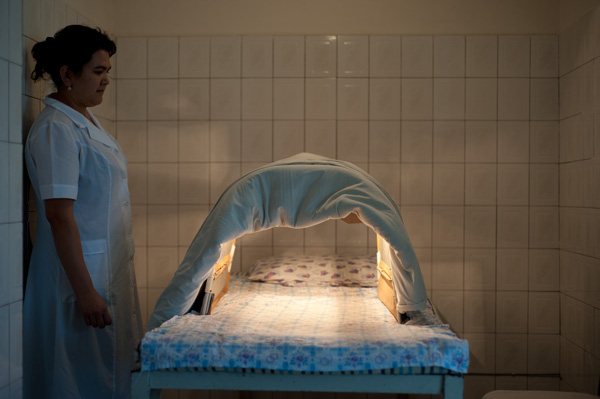
University sanitorium, Uzbekistan, 2010
Do my students make room in their lives for creativity to surface? My goal is to get them to leap into love with picture making.

University Photo Department, Uzbekistan, 2010
Art making is hard, but life without art is unthinkable.
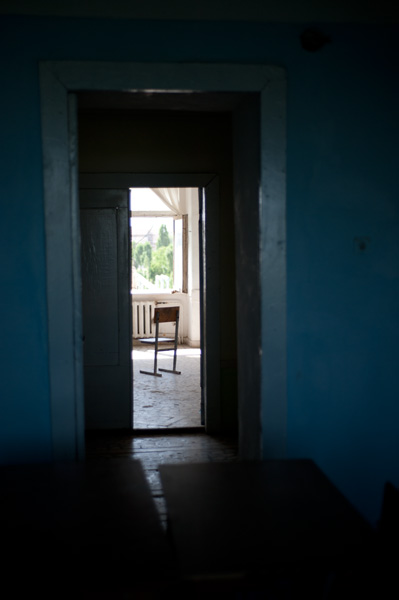
Hallway, University, Uzbekistan, 2010
Fresh from our department of self promotion– I am in a show at the Paper City Studios on 80 Race Street in Holyoke, Massachusetts that opens Friday the 8th of October 2010. It will run through October 30th. I’ll be showing pictures from Central Asia, but not the above images. There are 12 photography artists on exhibit including three talents to watch–Sarah Holbrooke, Dan Chiamis and Bob Horowitz.
Corn dogs and cow pies: The Big E
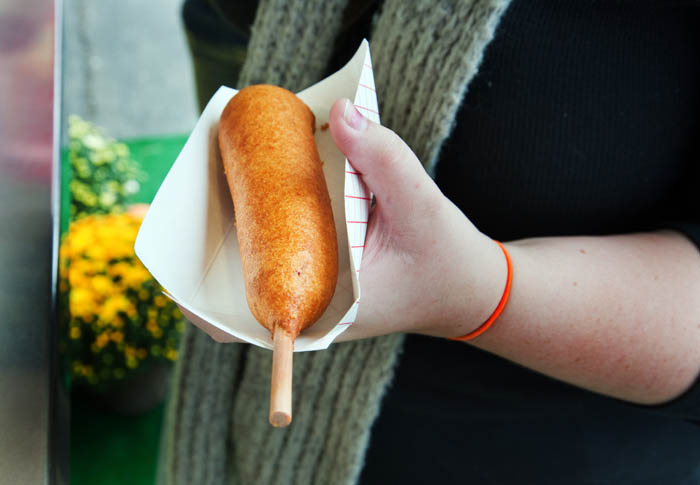
Corn Dog
My first visit to The Big E is all about the food.

Big sausage feast
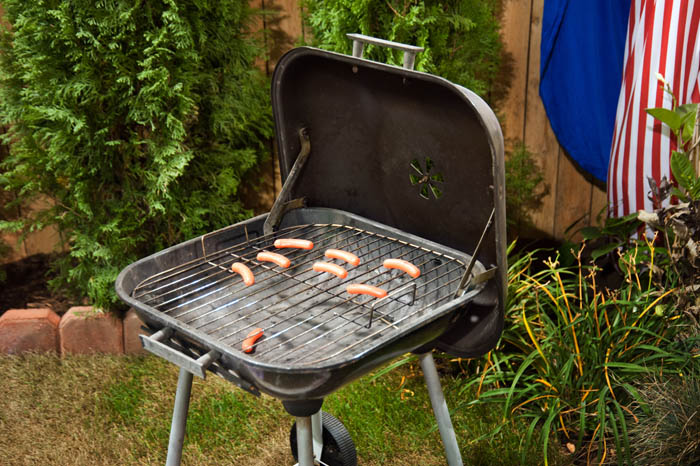
Little sausage feast
Once you have a full stomach, you have to move on. I move from cooked meat to the Farm-o-Rama and the horse stables. I find some strange behavior and the beginnings of a photo essay.
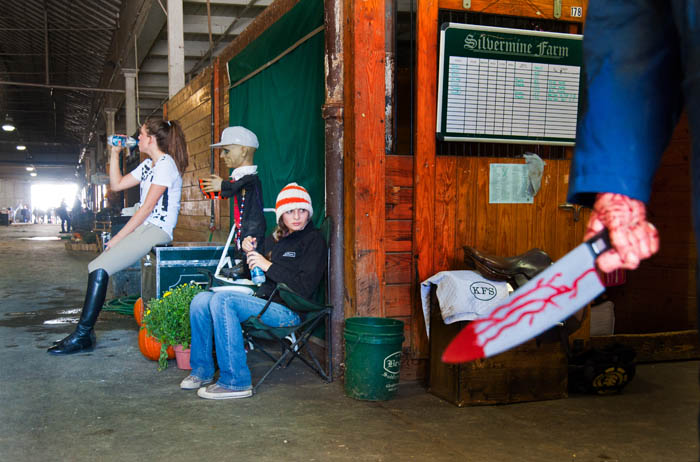
First, a bloody mystery develops.
I discover some heads with a non-human body.

Two heads and a cow back
As I search for other strange behavior, I see two headless figures surround a girl as she manipulates a personal digital device.

A girl and her cell.
Then there are more girls operating personal digital devices.
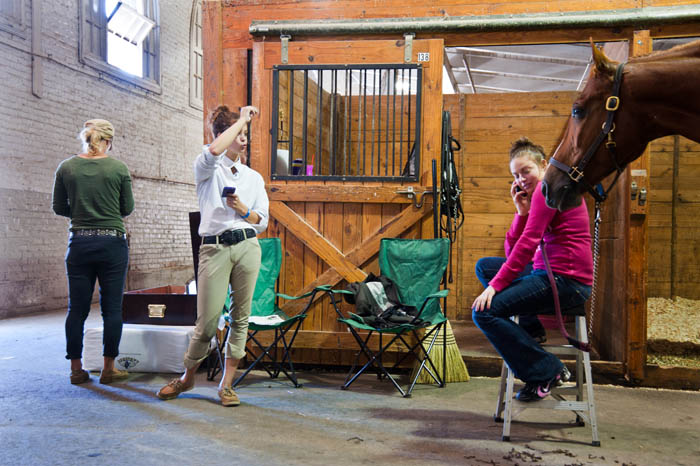
I feel bad for the horse without a phone.
I need a closer look at this suspicious cell phone activity.
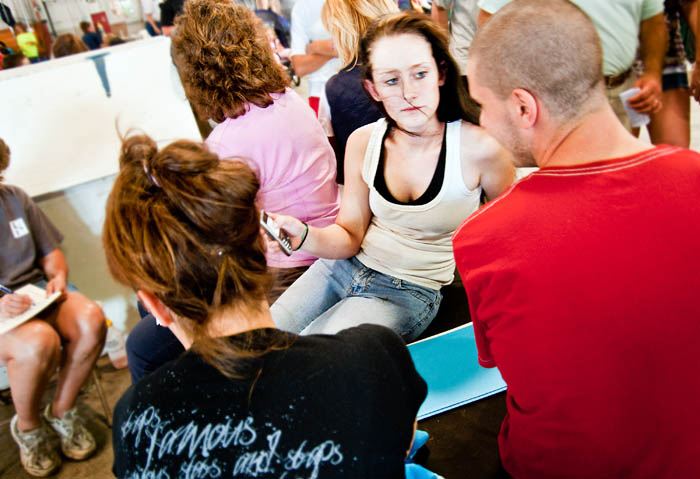
Person to person via a text message
Too much technology. I need some old fashioned 20th century human contact.
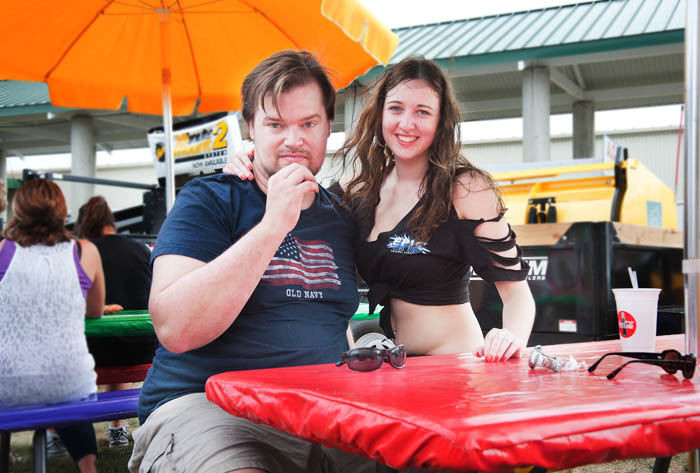
Man woman eat love
These table sitters exude magic and mystery. I am getting away from the cell phone people and finding fashion free folks of intrigue. I’m tempted to look under the table to see where her pants went, but I fight off the urge.
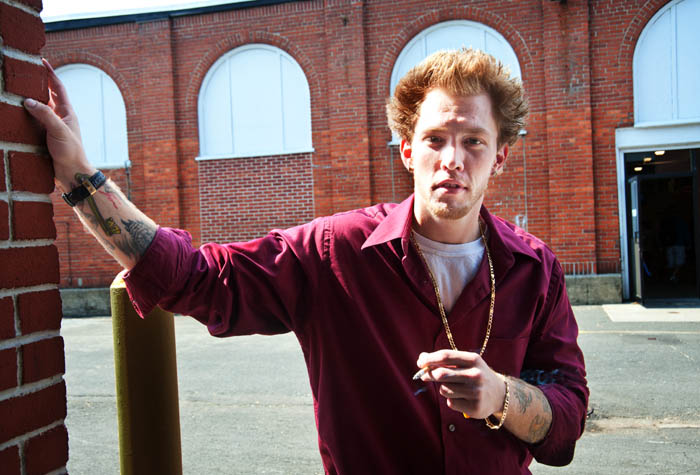
I meet Josh Miller while he is on a break.
The people visiting and working at the Big E offer the best reasons to be there. Even my photo students take on a luminous sense of purpose.
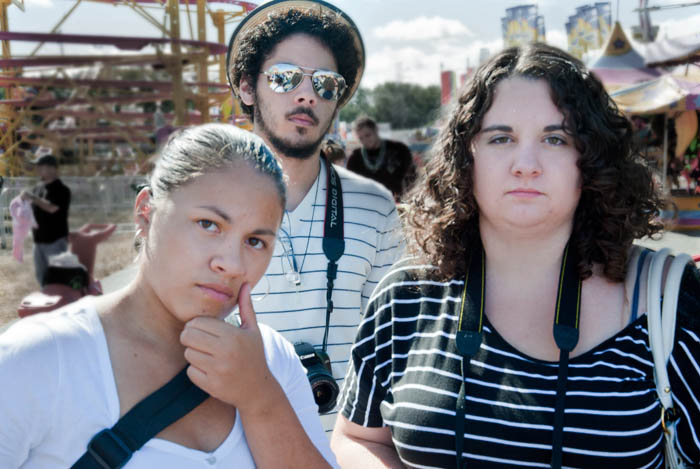
I should just photograph my students. They are tops.
My Photojournalism class has spent the past two Fridays at the Eastern States Exposition in West Springfield. We will be there again this coming Friday. For the assignment, I ask students to concentrate on one aspect of the fair and photograph it for at least three visits. I have found my subject with the people who attend. Even from behind, they are interesting.
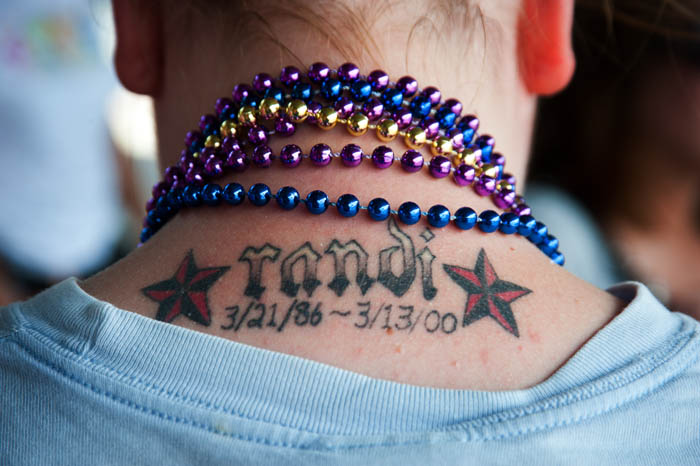
All photos by Frank Ward
Holyoke Unplugged

Today the canals went dry.
Holyoke drained their canals today. The water crew said they will be drained for the week. Personally, I love seeing the canals empty for a few days every spring and fall. It gives me a chance to see what has been underwater for the season. Mostly there are discarded shopping carts, bicycles and baby carriages.

Bike on canal bottom.
I photographed in the bright sun this afternoon and was interested in how the open shade and the open sun altered the color of the pictures. Both photos above are color pictures.
Last Friday I photographed a moderately full canal.

80 Race Street from the canal.
I am in a group photography show at 80 Race Street that opens on Friday evening, October 8th. It should be a good show with work by my pinhole hero Sarah Holbrook, and superb landscape photographers Michael Zide and Bob Horowitz. The Prince of Pixels Dan Chiamis will also be showing along with Steve Schmidt and a half dozen other artists that I have not yet met. I believe there will be lots of other exhibitions opening that evening. It should be a nice night for a canal walk. The canals will be filled by then.

Holyoke Street School, now defunct.
I’ve been walking around photographing the striking architecture . All my classes are in the process of being cleared for permission to photograph in places around town, from studios to construction sites. I’ve been talking to Holyoke’s new wave of artists and landowners. Our aim is to get out of the “ruin porn” rut that has plagued many photography projects in our disintegrating cities. There’s life in them there buildings. And there are artists and artisans making beautiful things. I talked to Quantum Properties about photographing their 16 acres of factories and mills as autumn progresses. There’s beauty and grace in Holyoke. Bruce at Quantum even told me that there is a yoga class that meets in one of their factory fields.

Window of Holyoke Street School
On the down side, our transportation coordinator is on vacation for the next couple of weeks. I can’t schedule any new fieldtrips until after she returns. That means that students should get down to the canals on their own. We’ll begin class visits in early October.
Four pictures for three classes
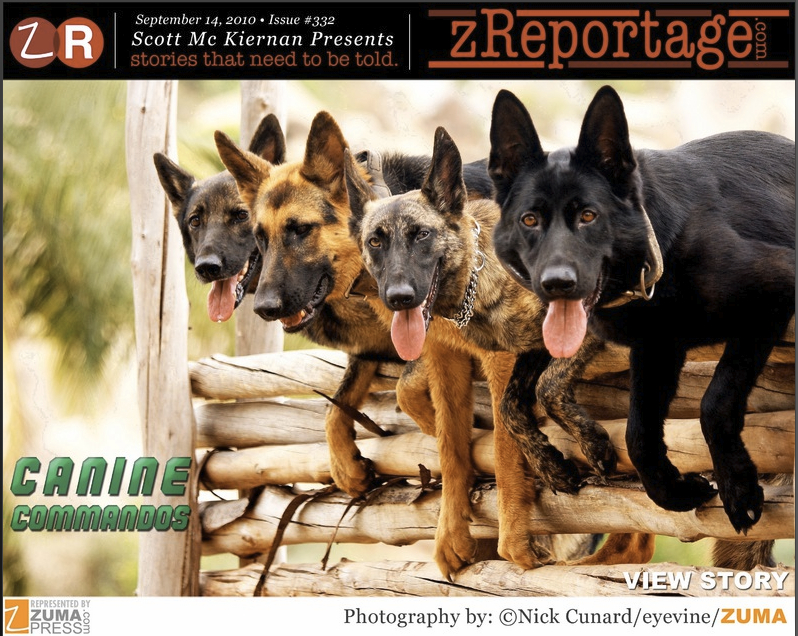
Check out Zuma Press for great photojournalism
I have three of my photography classes that I want to address in this post. First, the above picture is for my Photojournalism class. “Stories that need to be told” is a weekly posting from Zuma Press. They are an international press agency of which I am probably their least active member. They are consistently premiering great documentary work through several outlets. zReportage.com exhibits slide shows every week. Keep an eye on Zuma’s “The Pictures of the Day” website. It provides a great opportunity to see the best of what is being done.
from Lydia Anne McArthy's Refraction
The 2010 Conscientious Photo Contest winners have been announced over at my favorite blog, Conscientious. The above picture is by one of the three chosen artists by three top notch jurors. When I saw the Refraction series, I thought of my Digital Fine Art Photography class. The catch is that these pictures do not use digital manipulation. They are created by a homemade camera using a fresnel lens. If you don’t know what a fresnel is, ask someone in theatrical lighting. Lydia describes it as a “magnifying sheet.”
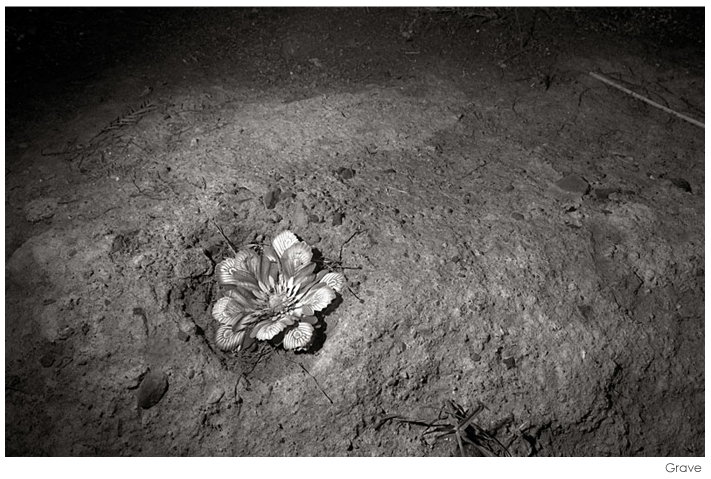
Grave by John Sevigny
Today, I am breaking several of the many guidelines I have for my Basic Photography class. First, I ask them not to photograph their pet dogs and cats (top picture). Second, I request them to have something in focus in the picture (second picture down). And I suggest not photographing in graveyards (above). Incidentally, I also suggest not using an on-camera flash (above again). So, I guess I’m telling students to not follow what I say to the letter.
By the way, John Sevigny is having a tremendous print sale of his moody Mexico photographs. They can be viewed here at Visura Magazine. He is selling 16X20 prints at a price so low that I don’t want to list it. Check them out and if you see something you like, contact him through his Gone City blog. I can guarantee that you will be surprised at the deal he wants to offer you. It is all part of helping him get a quality fine art book published.
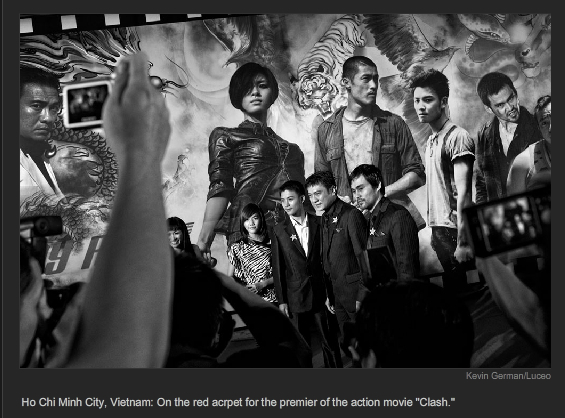 The above picture by Kevin German is for my Photojournalism class. Here is a link to “If Photojournalism Is Dead, What’s Luceo?” on the New York Times’ Lens blog. In fact, there are several stories on the net lately talking about the demise of photojournalism. Here’s one from the UK’s Guardian blog and “The End of Photojournalism” is in a recent Atlantic blog. I’m not trying to discourage photojournalism students. I’m trying to stimulate them to break out of the 20th century mold and help find a new role for concerned (or not), serious (or not) documentary photography.
Where to Begin

Jupiter, Florida, 2010
Summer ends and school begins. I took the past 7 weeks off from blogging to be in Massachusetts, Florida, and Maine. Now, I’m firing up the blog engines to accompany my Basic Photo, Digital Fine Art and Photojournalism classes. Welcome to all my students. I hope you are sufficiently energized from a long hot summer to start the semester “so fresh and so clean.”
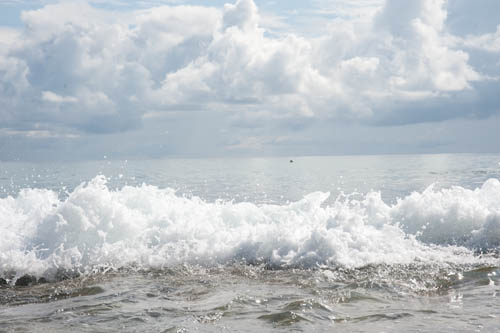
A fresh and salty Florida wave.
I took a little trip to Florida with my son and daughter to visit my parents. In between meals, we went to the beach.
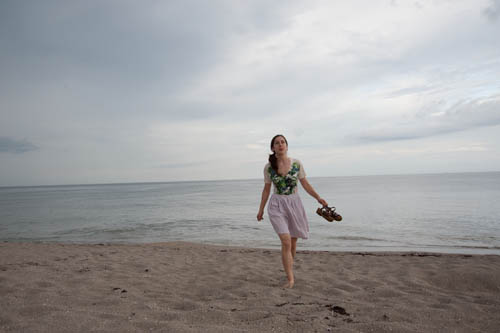
Tobey at the beach.
And we watched TV with the folks.
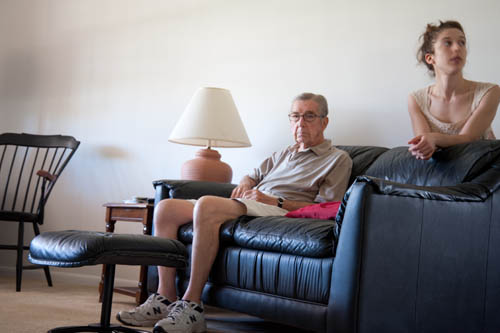
My father and daughter preparing for the torturous experience of Fox News
I love being with my 91 year old father as he glides through his daily chores.

My father and our rented Prius.
Back to the beach, this time in Maine.
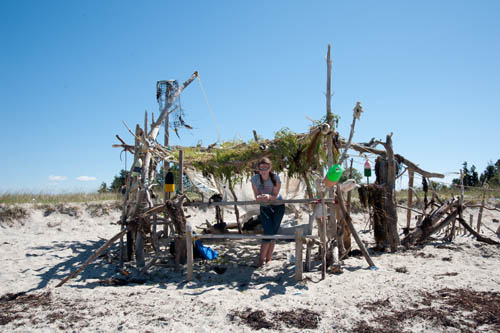
A driftwood shelter on a Maine island
Vivian and I visited friends in Maine for a few days. I ate every kind of shellfish known to Maine. We power boated and canoed around the Penobscot Bay area. Actually, I think we were just north of there in Waldoboro. I found Maine to be so beautiful, so New Englandy, and a bit too familiar to be able to comfortably photograph by day.
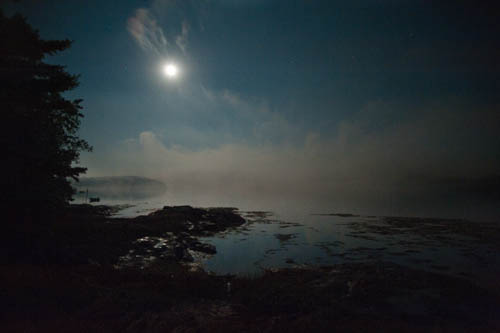
View from Nan's Nest, Waldoboro, Maine
By night, the convoluted magic of the Maine coast wove me into it’s spell.
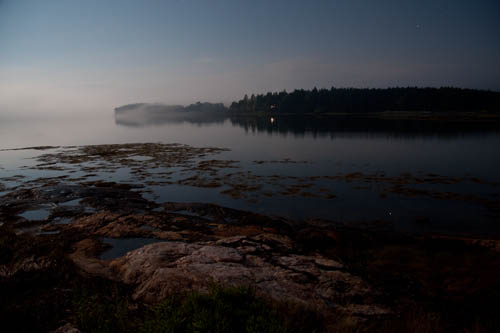
View from the deck, Waldoboro
Whether I was using the camera hand held, as in Nan’s Nest, or with a tripod (above), the Maine spirit imbued what I saw.
Florida always struck me as a bit bereft of soul. In Maine, I talk with the spirits. At night, even those who walk the earth by day take on a ghostly transparency.
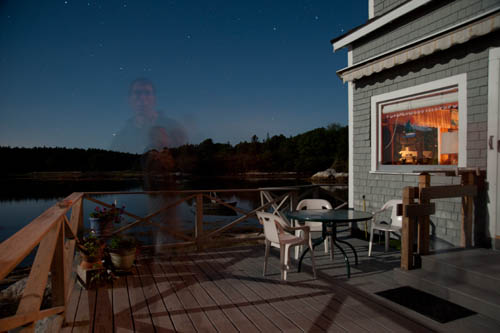
Richard as the spirit of Waldoboro
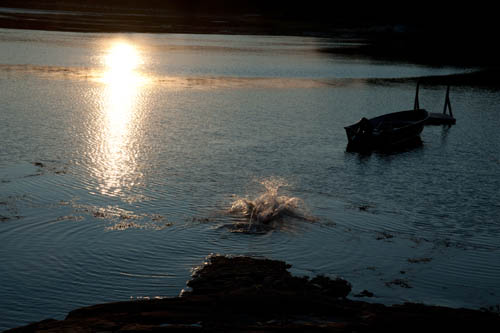
The spirit of Waldoboro takes a swim
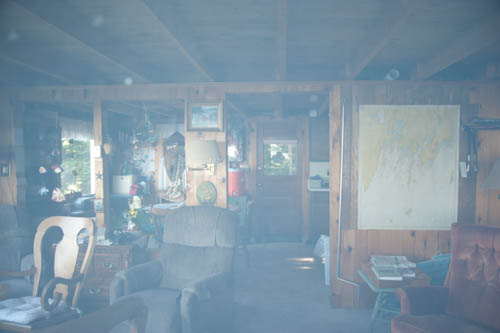
Nan's Nest through the screen door
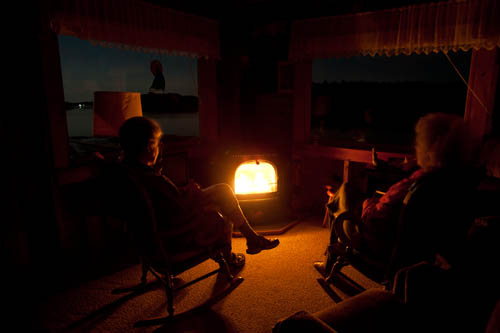
Wendy and Vivian talk by the fire
I feel a bit guilty about all the beautiful places I’ve been this summer. I hope everyone has had such a generous share of good times.
Now it’s time for a new beginning. I invite my students to join me in looking close to home for what is beautiful and important to us.
The Basic Photo folks will have the adventure of the chamber noir, the darkroom.
The Digital Fine Art class will have to resist the mechanical magic of Photoshop and reach for their own vision as interpreted pixel by pixel.
As for the Photojournalists, we are in it together. One five hour session a week will find us in the field photographing post agricultural, post industrial, and post historical Western Mass. We’ll make our own history. It’s all good.
The Avignon Theatre Festival-Off and On

Festival Posters at Avignon
I went to the Avignon Theater Festival yesterday. It was transcendent. Not just because over 900 performances a day are happening. It probably was because a great part of the audience were theater people. The festival is one big circle of dramatists chanting to each other.

Off Festival Programs
The festival is actually two festivals. The original “On” festival did not have to call itself that until the late 1960s when upstart theater people simply staged events throughout the city in the midst of the traditional drama festival. Now, the “Off” festival program is a phonebook sized manual of who, what, when, and where. The “On” program is half that size.

Two posters echo the On/Off relationship.
When I arrive in the early morning Avignon feels open and welcoming.

It is great when the old guard, symbolized by Oscar Wilde (right), is as dynamic as the new guard.
As for the festival itself, it’s all energy and that’s what I am here for.

Actors on the street approach me.

Faces in the crowd are actors on the stage.

This couple are playing Bridget Bardot and some famous French actor.

Lady Dia is just being herself, and that is enough for me.
The street pulsates with life. Lady Dia exits, others enter. This is all and everything. A bicycle housing a piano provides the soundtrack.
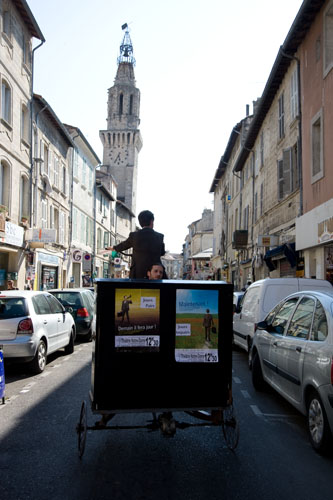
The music on the street propels me forward.
Occasionally, someone lifts a horn out their door for counterpoint.
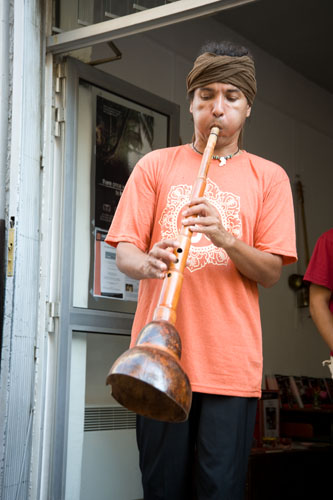
The cobblestones start to vibrate as the sounds echo deeper.

- The light dims and the third act begins.

The barkeep tells me that they have 160 different beers, I know my first choice has to be from Belgium.
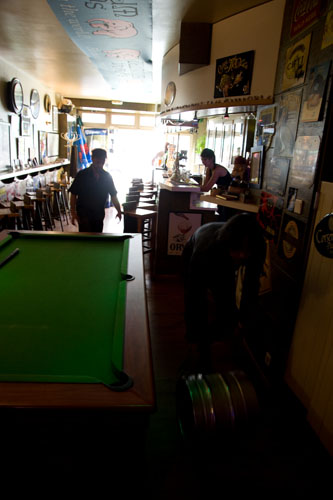
Native dancers are keg rolling.
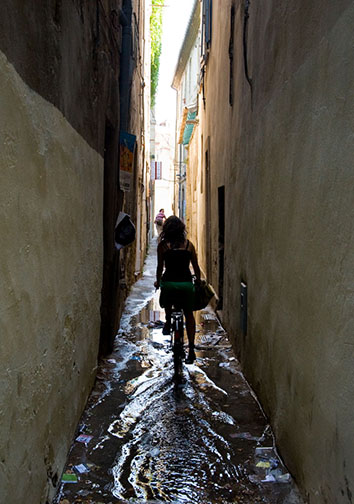
A lone cyclist rides down the alley.

Two girls approach me.
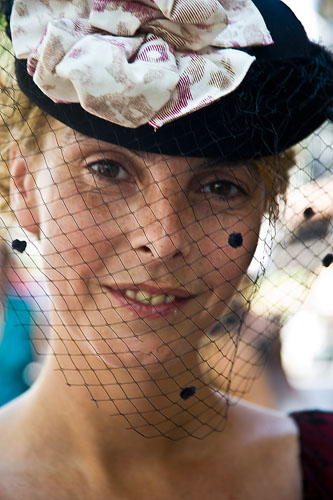
A face stares through a veil.

I ask, what makes my heart sing?

I fall into a photography shop and the woman in the picture talks to me in French.
I’m not sure what she is saying. I remember Satori in Paris, Jack Kerouac’s book about a flash of enlightenment experienced in a taxi cab.
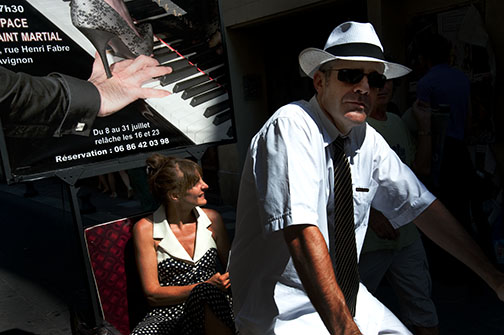
A bicycle with a piano and a high heel.
I need transport to the terminal.

At the bus station.
Now, I don’t have to go anywhere. I just sit on the bus. I just sit. There are over 900 performances a day. More than that if you don’t try to keep count.
The Arles Photography Festival Deuxieme Partie

What's new seems old again
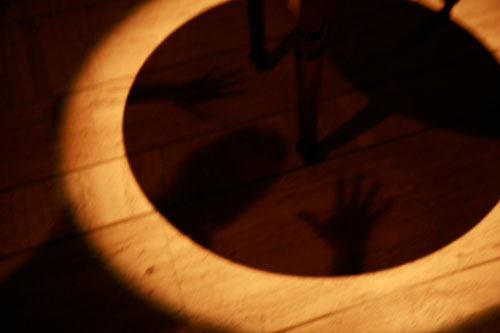
The spotlight in the above picture is pointed at the glass shattered over a framed photograph lying on the floor. Arles, in trying to maintain it’s “cutting edge” exhibition record, has opened the flush gates to any possibility or idea that an idle artist or curator might have. In some cases, really good work is debased by the decision to mount the pictures as tabletops reflecting overhead lights rather than that “old fashion” wall mount system known as hanging. Michelangelo already painted a picture on a ceiling. Why do we have to pretend that horizontal areas are new mounting surfaces?
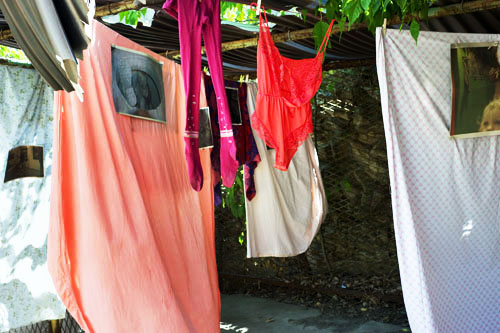
Hanging unannounced on the way to the galleries
I walked by this photo/laundry installation on Wednesday. When I returned on Saturday, I swear that the laundry and the pictures had changed. Now this is a practical innovation in vertical hanging that integrates well with our daily lives.
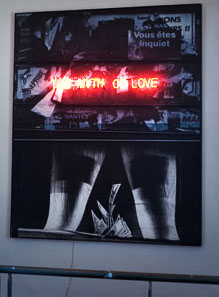
Neon art by Peter Klasen
The Myth of Love was the one interesting piece in Peter Klasen’s show and reminded me of my college buddy Bill Kane‘s neon work. Unfortunately, the link is to his landscapes. Whatever happened to Bill Kane’s neon work? He used to rent them for exhibit in Hollywood movies as art to hang in the background. He really made Robo Cop worth seeing.
On the floor below Peter Klasen’s gallery was the best retrospective at Arles. Italian photographer Mario Giacomelli presented a huge show of his high contrast interpretations of the Italian world.

Young priests dancing by Mario Giacomelli
My personal favorite show by an artist I hadn’t previously known is Klavdij Sluban‘s Transsiberiades.
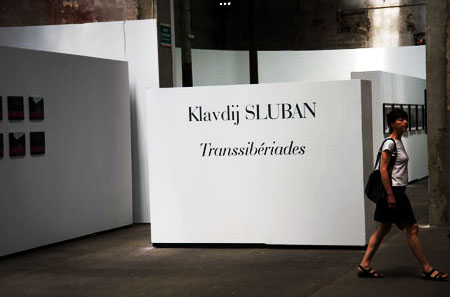
My favorite exhibit in Arles.

A wall by Klavdij Sluban
The Transsiberian Railroad, a Leica, and a pile of 3200 speed film make for a connection to Siberia and the East that floored me.
After seeing Sluban’s evocative work, I had no choice but to face my own limitations and return to photographing my students.

Students Tanya and Tsion wait for me to leave the exhibition.
Fortunately, I have great students and am living in a world of great opportunity. For instance, I had the rare opportunity in Arles to use an original French streetside urinal.

This was the first traditional pissior that I saw in over a month in France.
As an added bonus, Miss.Tic lies prone at the urinal entrance.
Miss.tic is a fictional graffiti celebrity in France. I have seen her everywhere.

Miss.Tic protests Botox.

Gun and assorted questionable things.
I find that going to exhibitions or cinema, and performances in general, opens my mind and alters my perspective on the world around me. While walking with my eyes truly open, I see things. I saw the (above) gun out of the corner of my eye as I passed an idling car.
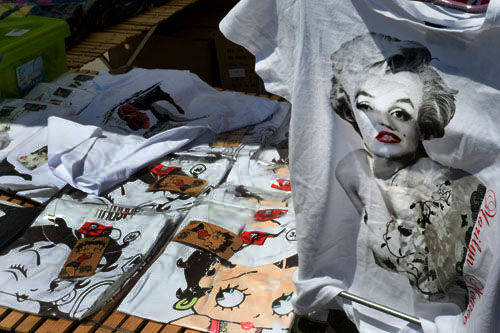
Betty Boop and Marilyn Monroe
Betty Boop and Marilyn Monroe vie for my attention from a market stall. The world is simply full of stuff to photograph.

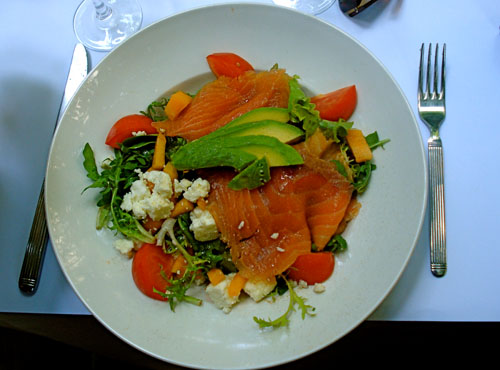
Andrea made a delicious salmon and shrimp salad dinner.
And, France in particular, is full of good stuff to distract me from photographing. I did manage to squeeze off this picture in the garden before embarking on yet another transcendental eating experience.
Les Rencontres Arles Photography

Love Letter to Mick Jagger
“Heavy Duty & Razor Sharp” is the headline on the map they hand out when you buy your (very expensive) ticket to 60 photography exhibits at the 2010 Arles Photography Festival. This is a big festival that takes over much of the little city. The festival is strong on quantity. But the majority of the exhibition spaces, which were ancient churches, abandoned industrial areas, etc., are more interesting than the exhibitions themselves. The Mick Jagger show, for instance, is neither Heavy Duty, nor Razor Sharp. The venue is vastly more beautiful than Mick.

Augusto Ferrari Exhibition in Saint-Trophime
Argentinian artist Augusto Ferrari gets tabletop treatment in a beautiful cloister. His son Leon (below) is the Guest of Honor at this year’s festival. Leon’s retrospective integrates and transcends the spaciousness of Eglise Saint-Anne.

Just a few samples from Leon Ferrari's retrospective.
As one example of all that Leon Ferrari creates, he inscribed Jorge Luis Borges’ poetry onto the appropriated photos (above) with braille written across the represented flesh. His radical reconstructions illustrate how fresh a visionary can be. Leon had one of the few great exhibitions in the Arles “Heavy Duty & Razor Sharp” festival.

Entrance to the Collection of Marin Karmitz
One of my favorite shows was the Marin Karmitz Collection at the Eglise des Freres Precheurs. Cinematographer Karmitz collects artists in depth. The Christian Boltanski installation below was a perfect marriage of concept and environment.

Installation (detail) by Christian Boltanski
Karmitz’ collection also includes Michael Ackerman and Christer Stromholm.

Work by Christer Stromholm

Accordian book by Michael Ackerman
Michael Ackerman is a personal favorite because his photography feels totally candid, totally visceral and totally risky. See his work on the Agence Vu site.

A film about the creation of Nicephore Niepce's 1827 photograph.
So out of the 60 plus photography exhibitions on view in Arles, I saw about 8 that were great. The Nicephore Niepce Museum was well represented with an installation that we hadn’t seen when we visited the museum a couple of weeks ago. This show really conjures up the ghost of Niepce while quoting from Roland Barthes’ final work of criticism, Camera Lucida.

Rue Robert Doisneau
There wasn’t a Robert Doisneau show in Arles this year, but he did have a street named after him. It’s not as wonderful as the street named after Eugene Atget in Paris.

Rue Eugene Atget, Paris
Tomorrow I return to Arles with my class. I’ll do a duexieme partie post on the Arles festival later in the week.
Today’s parting shot is of the room in Aix that I visit daily.
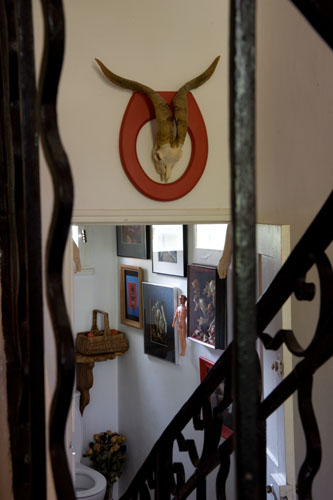
Bathroom installation by Tommy Elder
Aix Students
Food study 1 by Amber Horvath
In yesterday’s critique, Amber presented a really strong visual argument for “Why Aix?” Here are four of her pictures that speak for themselves.
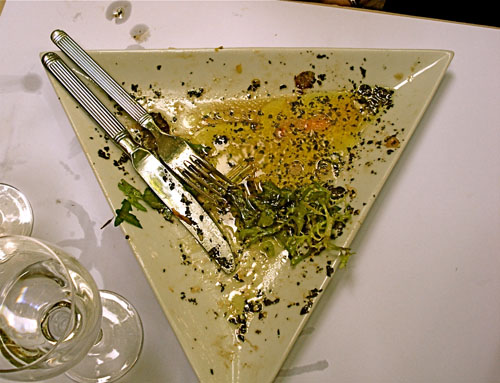
Food Study 2 by Amber Horvath
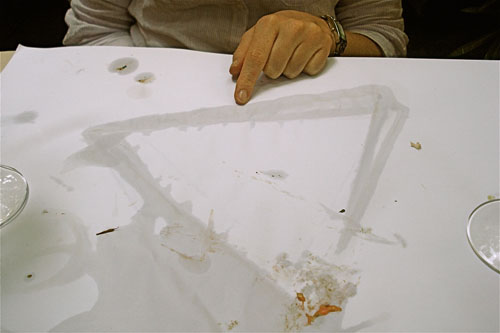
Food Study 3 by Amber Horvath
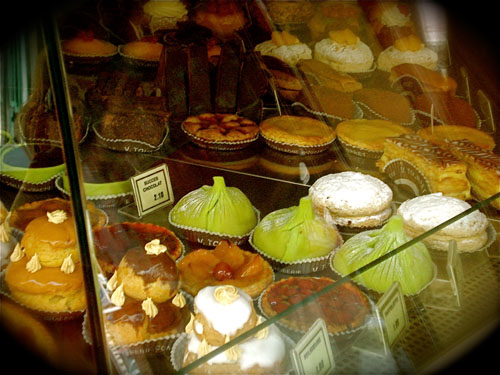
Dessert by Amber Horvath
OK, these are not from Aix. I realize that Amber actually photographed these meals in Lyon and Chalon. Below are Tracy Konig’s vision of the same trip to central France.
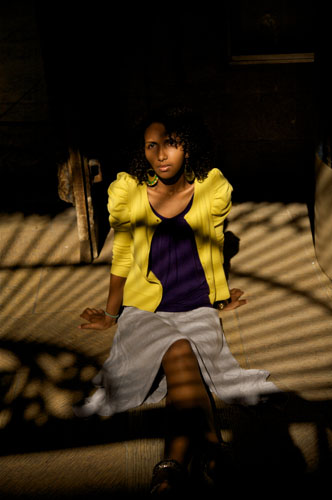
Tsion by Tracy Konig
From the Niepce Museum(Michael) by Tracy Konig
Tsion at Niepce Museum by Tracy Konig
Amber in Lyon by Tracy Konig
I have so many good pictures from everybody; I don’t want to keep posting more from Amber and Tracy just because they are the most recent.
The class will go to the Arles Festival of Photography on Saturday. I hope to post more student work soon after that.
More Files from AIX
Cafe, Aix, by Louise Chapin-Lehire
We haven’t finished our first critique. We’ll do that this afternoon. Here are a few more of my student’s pictures. Louise’s nighttime cafe shot reminds me of a Robert Frank photo without the jukebox and cowboy hats. OK, so Robert Frank’s The Americans was all about jukeboxes, cowboy hats, TVs, American flags and frowns. Actually, the French are good at frowning, they just don’t wear cowboy hats.
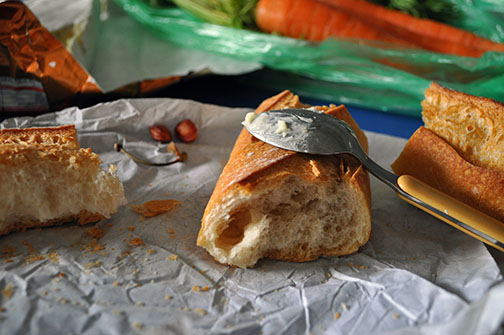
Bread by Anna Jackman
What the French do best– cheese, bread, wine–is the subject of Anna’s picture. OK, so it isn’t about the wine; students did comment on the cherry pit smiley face that she subtly inserted.
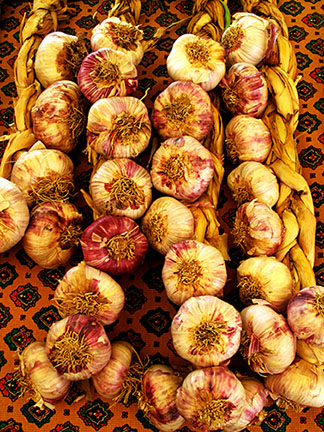
Garlic by Virginia Hill
If we weren’t in such proximity to Italy, I’d say food is what the French do best. They stole so many good ideas from the Italians. They slipped-up when they omitted pasta and red sauce from their daily diet. I will say that they came very close to winning the world cup of cuisine with the simple cheese plate at the end of their already tasty meal.

Carousel by Bridget O’Carroll
I was looking at the pictures above and thinking how each one incorporates what I look for in a photograph. Starting with Louise on top, her picture is about light. Then, Anna does a delicious job of illustrating textures. Next, Virginia offers beautiful garlic forms placed on a complimentary pattern. And Bridget manifests energy or motion by smart use of her shutter speed. Finally, Louise’s leg picture below celebrates gesture and expression with a fresh framing.

Aix in June, by Louise Chapin-Lehire
I still have two more student artists to post after their critique today. For now, I’ll end with an American icon that even the prescient Robert Frank neglected to represent in his historic book.

Marilyn Monroe for ever in an Aix shop window.
American Students Aix
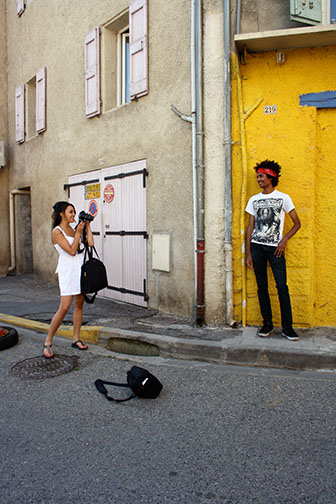
Liz and Michael by Bridgett O'Carroll
Here’s some student work from our first critique. Liz, in Bridgett’s picture above, tried to get into my class, but it was already full. Then, she dropped her camera and decided she liked the pictures created with the shattered glass of her UV filter. She’s a student who adjusts well to adversity.

Street musician by Julia McKenzie
Speak about a student who can adjust in the face of adversity, Julia made this one on the street near our classroom. I should have printed it smaller.
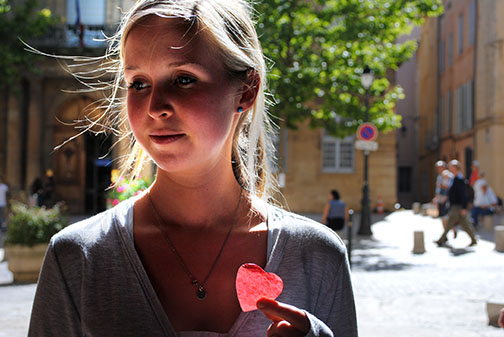
Virginia's Heart by Michael Habermann
Michael’s lovely picture of Virginia is a good reminder of the beauty to be found through photography.
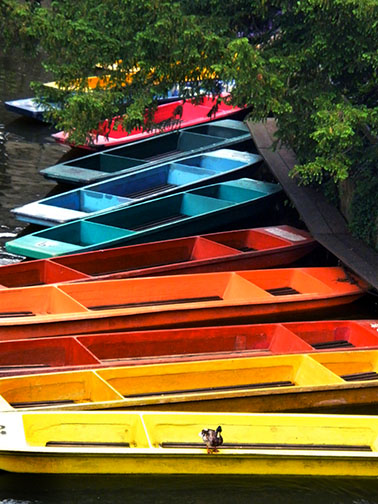
Boats by Virginia Hill
Virginia also knows beauty, even though she included a duck in the bottom of the frame.
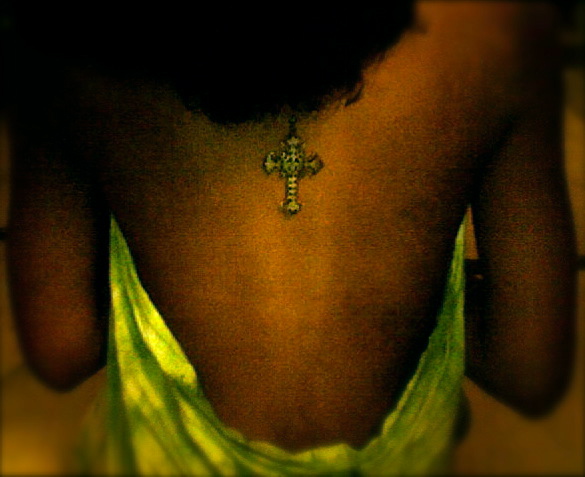
Student Self-portrait
It is so wonderful how almost all my students wear dresses and skirts daily. Aix can be casual, yet it feels better when one looks great. For me, I walk around as if cast in a “new wave” French film circa 1965; the dresses help with the illusion.

Julia in the bar, by Louise Chapin-Le Hir

Amber by Tanya Arora

Amber at the window by Mosettee Lorenz

Student group by Michael Habermann
I’m calling this post Ameican Students Aix in reference to a great photo blog called American Suburb X. Check it out.
 The Coruscating Camera

