The Shape of Things that Are

Soccer Field, Gobi, 2008, Frank Ward
As a continuation of yesterdays post about the HCC Photo Club Photo Show, here is another example of forms in space. This picture is part of my featured exhibit for the month of September on the Turkish web magazine Fotoritim. The mag has a lot of interesting portfolios so don’t think you have to go there just to see my work.
Before I get to the HCC Photo Club info, I want to direct you to an article for developing photographers. I’m trying to get my students to look at art forms other than photography for inspiration. John Sevigny sent me an email this morning with an article he wrote about looking at painting.

John’s article clearly expounds on what I was thinking about. Read it all here. Check out John’s Gone City blog here. Look at a John Sevigny picture below:
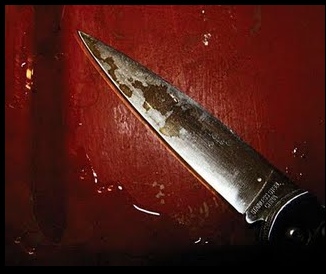
Trio (detail), 2009, by John Sevigny
The HCC Photo Club Rub
I spent awhile last night trying to consolidate the 3 HCC Photo Club Googlegroups. I wasn’t particularly successful so I switched over to Facebook. If you want to participate in our “The Shape of Things that Are” photo show/contest, here are the guidelines:
The HCC Photo Club On-Line Competition/Group Show
Logistics for Entering:
All HCC photo students, as well as Photo Club members, are invited to participate.
All HCC Photo Club alumni are also invited.
Submit pictures to the HCC Photo Club on Facebook (you probably have to be a Facebook member to do it.
If the upload doesn’t work for other reasons, send jpegs to fmward@gmail.com
We want JPEG submissions only, with a file size of around 300K. 1024 pixels on the longest side will project the best.
If you don’t have digital, you can submit a scan from print or film.
Up to 3 submissions per person. You don’t have to submit all files at once.
Place your name in the image or canvas area if you want to be acknowledged in the slideshow. Otherwise, your name will be listed separately.
Deadline for submissions is October 24th, 2009.
Winners published on The Coruscating Camera will be composed of 10% of all the people who sent in pictures. 100 applicants will result in 10 pictures represented on-line.
Editorial privileges apply. The Trustees of Holyoke Community College are prohibited from entering the contest, but they can join the MAC Open House Show.
At least one picture from every contributor will be shown in the presentation at the Holyoke Community College Media Arts Center Open House
on October 28th, Wed. 4:30-6:30.
Here’s the theme:
Geometry, but not necessarily abstraction.
Shapes of buildings and objects, but not particularly about what they literally are,
Pictures about forms in space– floating, sitting, being thrown, held, dropped or just stuck in the ground.
Beautiful pictures about circles, squares, rectangles, ovals, rhombi, trapezoids, triangles, etc.
Please peruse my last few blog posts for more pictures and comments about the theme.
The Ketchup Bottle of Creativity

Rockport Sunrise, 2009, Abe Morell

New Work from 2009 by Abe Morell
I’ve spent the past few weeks gently banging on my student’s bottoms. Like ketchup bottles, you don’t want to bang too hard or you may have a mess on your burger. Well, I have come to realize that banging hard, shaking the bottle violently, and even sticking a butter knife into the cantankerous container may be necessary actions to get what you need out of the bottle. It doesn’t really hold true that too much catsup is undesirable. I’d be as happy as a fully ketchupped burger if my students were putting up pictures as if they were wallpapering the crit room. More is better for my students because any outpouring of primordial ooze will give us something to work with.
There are many good signs. First, students all seem to like Abelardo Morell, the deservedly well-regarded Boston area photographer who teaches at Mass Art. He brings the early impulses of photography’s inventors into present day tangibility. He is illustrating what to do with a camera when you aren’t particularly seduced by the zoom and flash, the rattle and hum, of a small, hand-held automatic plastic box . We don’t all want to be photojournalists, fashion photographers and documentarians.
Actually, I have another reason for mentioning an old U2 album title. The new U2 album has a striking cover by one of the great living minimalist photographers.
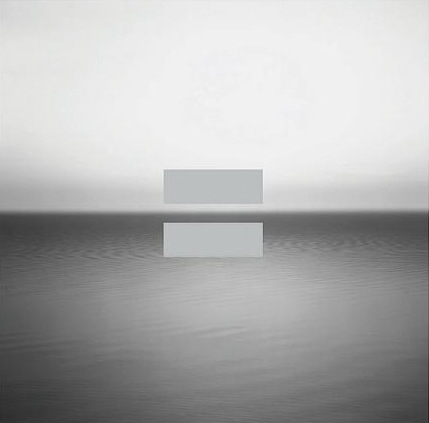
No Line on the Horizon by Hiroshi Sugimoto
There’s a neat story about Hiroshi being at a recent U2 concert and getting a shout-out from Bono here.
I did not grab this screen shot because I’m a U2 fan. The only Bono song I really like is on an old duet album with Frank Sinatra.
I like Hiroshi Sugimoto. I showed one of my classes Sugimoto’s pictures of movie theater interiors with the films running. All of the pictures encapsulate a glowing white screen. The length of the movie determines the length of the exposure. Why didn’t Abe Morell think of that?
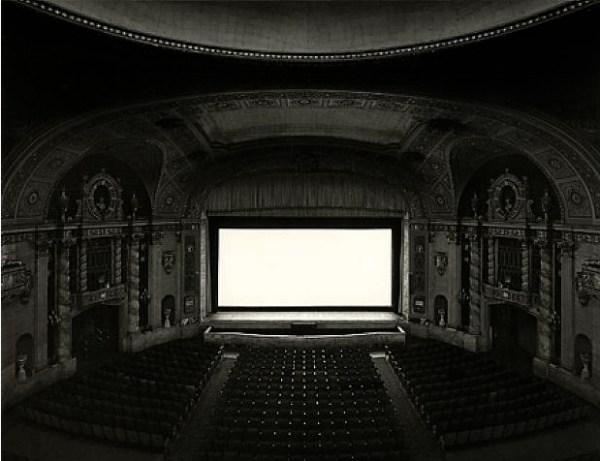
Theatre by Hiroshi Sugimoto
Has anybody noticed all the Sugimoto and Morell rectangles floating in space? They remind me of my old UMass buddy Bill Kane. Back in the 80s and 90s he was floating actual rectangles of stuff on top of his photographs. He did a great series about Walden Pond.
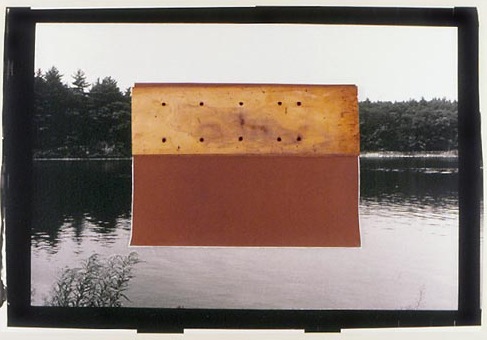
From the Walden Pond series by Bill Kane
Bill is still floating shapes in space. This is from his New Transrational Works.

Bill Kane, 2008
This 35X83 inch pigment ink on canvas work may look familiar. Take Bob Aller’s History of Photography course to find out more about Bill’s sources and inspiration. Damn, I don’t think HCC will offer it until fall 2010.
This brings me to a special invitation to the HCC Photo Club to do an assignment. I’ve been thinking about all the geometric shapes that inhabit our environment, from “big box” stores and road signs on poles to soccer balls on lawns and balloons in the air. I’d like to see pictures of this geometry deconstructed so they aren’t pictures of signage and buildings and neighborhoods and lawn parties, but indicators of new harmonies– celestial bodies, geometric theories, childhood building blocks (see Abe Morell below), new abstractions. The assignment is to turn objects, like the ever-present billboard, into a less literal symbol of mass culture. Make pictures about the shape of things that are.

Toy Blocks, 1987, Abe Morell
I was about to post a link for club members to upload submissions to our Googlegroups site. I discovered that we have three HCC Photo Clubs on Googlegroups. I’ve got to find a way to put them all together so, more on this later.
In the mean time, if you want to submit to a contest with real prizes, check out http://socialdocumentary.net
 More on this later.
What Makes a Picture?
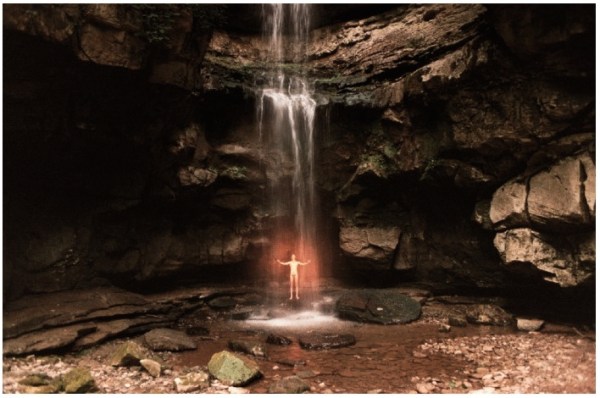
From the forthcoming book Moonmilk by Ryan McGinley
The “gee-whiz” factor of our college’s new photography facilities have settled down and now students are left with what all artists face. What to do? Making art is certainly aided by a good place to create and some support from your peers but, ultimately, art making is a personal endeavor. In an effort to ease the way, I’ve been showing work to all my classes that has been, or can be, made in the local environs of Western Mass.
Some of the pictures from Moonmilk, the book the above photo is taken from, could have been created in the Howe Caverns in nearby upstate New York. To photograph nudes wandering through the heavily touristed caves must have required some serious negotiations on the part of photographer Ryan McGinley. I remember photographing at a military fortress which had been turned into a state park in Maine with a class led by Joyce Tenneson. About twenty of us were gathered around some male and female models near a row of gun turrets along an underground corridor. We had watchers posted at each end warning us when tourists or guards were coming. When the park rangers finally busted us, I thought they were going to arrest us for obscenity and indecent exposure. Fortunately, it was the early 80’s.
In 2009, when it is prohibited to photograph on almost any property deemed private, like a shopping mall, or public, like a subway, photographers have new challenges to deal with before they can even make an exposure. This overall attitude of “NO!” is balanced by the fact that almost every human being is walking around with a camera (mostly in cell phones) and the official paranoia usually doesn’t kick in until security people see a tripod or a (D)SLR.
Photograph the Specifics > Transcend the Generic > Reach for the Universal
There is an answer to the question of what to photograph. I’m throwing out the old rule of forcing students out of their comfort zone to take risks. Young artists need to get comfortable with who they are, where they live, what they do. This is life, and it can offer beautiful pictures. So, get comfortable and get personal! I’m not talking about kicking back and hanging out. I still want students to face some fear. I’m asking students to pay attention, to stay awake, to see themselves with clarity and to cultivate a visual consciousness. Let your camera be the excuse for living more creatively. Let it be your fantasy machine, your memory box, and most importantly, a tool for experiencing your daily life moment by moment.
I’m asking students to photograph their outer and inner worlds. I don’t want to see pet portraits. I want to be surprised. I want to be impressed. I want to celebrate what they celebrate and love what they love.
Here’s the rub. Art must transcend the prosaic, or, at the least, celebrate the everyday with undeniable abandon. Let vision take over.
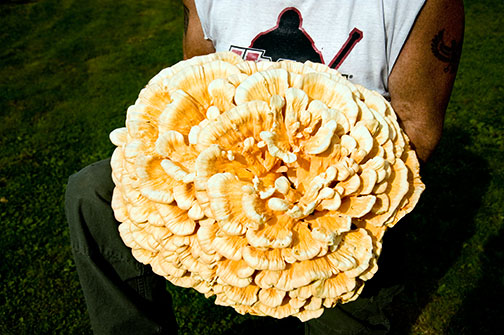
Joe's Mushroom by Frank Ward
My neighbor, Joe, dropped by last week with his latest find. I grabbed this picture before he went off and sold the sulphur mushroom for $50.
The Media Arts Center

Yes, the brand spankin’ new Media Arts Center is now up and running at Holyoke Community College. Above is a prototype plan for the center initially proposed by Professor Robert Aller in 1977. Over 30 years in the making, the final MAC is now outfitted with Apple computers (rather than the Windows machine pictured above).
I am hesitant to release any photographs of the new facility before our brochure goes to press. Here’s my Basic Photography class as they appreciate the “feng shui” dynamics of the critique room.

First lesson of Basic Photography–Don’t place yourself at the sides of a picture when you know the photographer is using a wide angle lens. I even transformed the distortion to try to make the students on the right and left look more normal. You’ll just have to take my word for it.
Second lesson of Basic Photography– The people at the back of the room are not midgets or munchkins, but also normal people similar in characteristics as the students on the far right and left.
Third lesson of Basic Photography– Rather than letting this distortion of human proportions ruin the picture, as in the above example, use it to your advantage to make a better picture. See below.

Fashion Week
Fauxtography
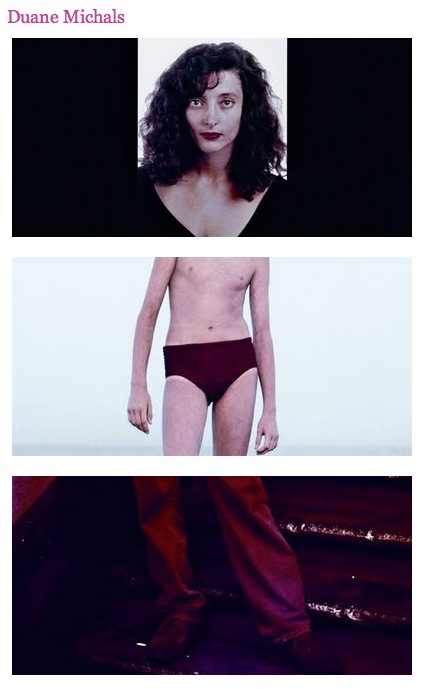 The Düsseldorfer Avant-Garde Foto Kunst Akademie of Derriere Garde Photography. Thomas Ruff and or Rineke Dijkstra and or Wolfgang Tillmans, 2001
© Duane Michals
Tattle-Tales from the Land of Fauxtography:
#3 Never trust a photograph so large that it can only fit inside a museum.
#4 Color is the new black and white.
#6 The announced demise of the decisive moment is premature.
#9 Photographers whose next three books will look like their last three books should quit.
#16 Museums should never exhibit photographs of visitors looking at art in museums to visitors who are looking at art in museums.
#21 An eight-by-ten inch photograph by Robert Frank can be heroic. An eight-by-ten foot Gursky is just a billboard with pretensions.
#27 Fashion photography is often artful but seldom an art.
Text and pictures courtesy of 1000 Words Photography
8 or 10 Reasons to Make Pictures
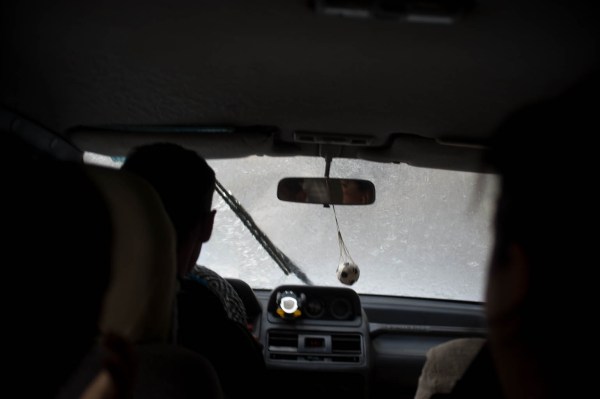
Driving through a waterfall in the High Pamirs of Tajikistan, 2009 by Frank Ward
I thought about this picture as I stared out the window on this rainy day in Ashfield. Then, I looked at my friend Clayton Salem‘s picture that he took at my house a week or so ago and I remembered that making pictures is more about where a photographer’s head is at than his body.
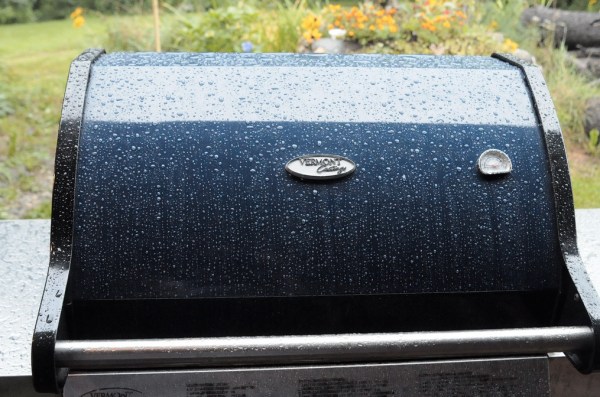
- Grilling in the rain, 2009, by Clayton Salem
I’ve been thinking about my photo classes and browsing blogs looking for new work that might be of interest to them. A good picture is often good for unquantifiable reasons. It got me wondering about composition.
THE BLANK CANVAS
We can look at our picture making process in a similar manner to painters approaching a fresh canvas. The first thing a painter may think about the canvas is its size. Photographers don’t think about scale often enough. In fact, it is rather curious that photographers seem to prefer a consistent scale in any body of work. A painter may do that also, but the first consideration is how to approach the dimensions of the canvas before his/her eyes. Photographers are cursed, or blessed, with a tunnel vision view through their ground glass viewfinder. That view is most often at a much smaller scale than any print that may result from the photograph. Adding to the blank canvas concept, the photographer is also immediately challenged by the fact that the viewfinder is filled with, often unnecessary, stuff.
What to do? Start looking wherever you can find vast spaciousness- the sky, the floor, pavement, grass, leaves, walls, night, close-ups, backdrops and add what catches your interest from there.
Here are some contemporary examples of pictures made with a fair amount of spaciousness:
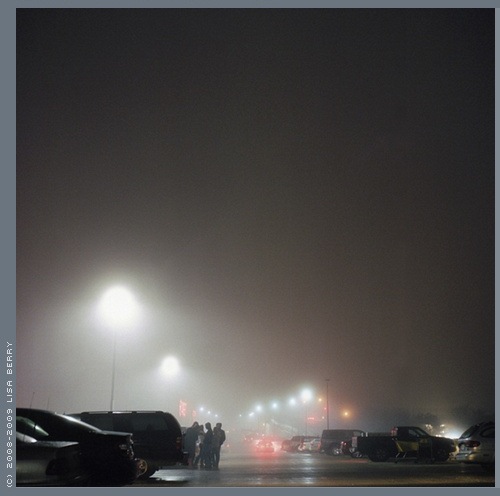
- Holyoke Mall, 2008 by Lisa Berry
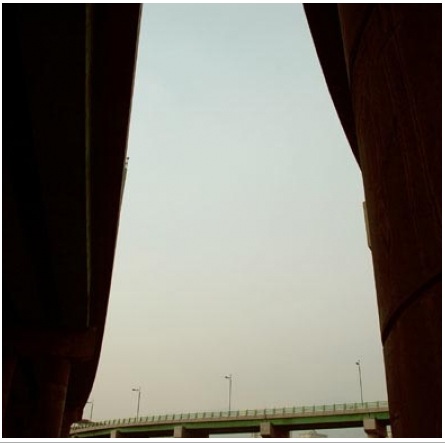
- by Mohammedresa Mirzaei, 2009
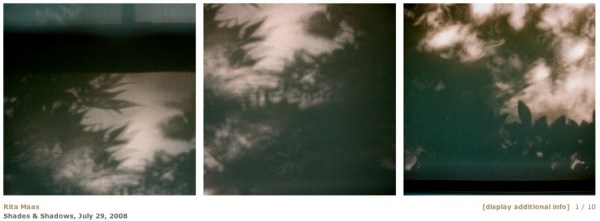
- By Rita Maas, 2008
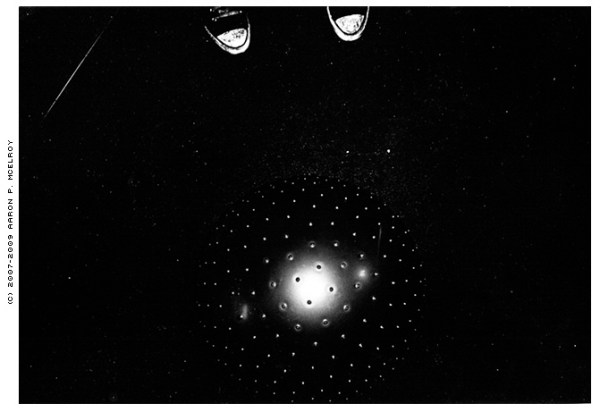
- Untitled, 2009, by Aaron McElroy
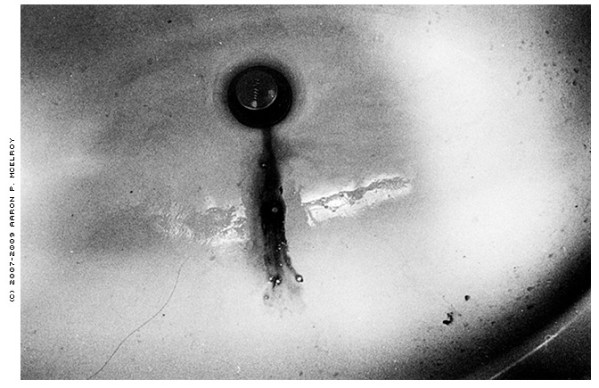
- Untitled, 2009 by Aaron McElroy
Aaron McElroy also has a fascinating series of street portraits. These are quite unique yet, they are made with traditional 35mm negatives and silver printing.
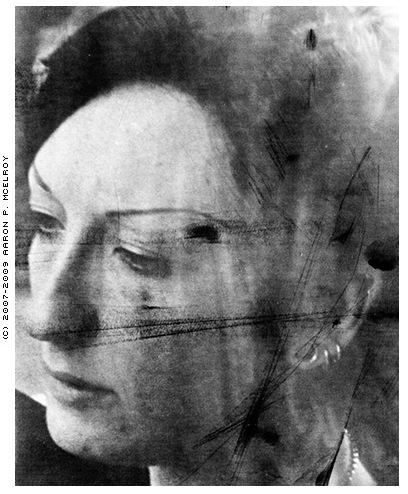
- Dolldrums, 2009 by Aaron McElroy
A special thanks to Jorg Colberg for the Aaron McElroy tip.
You may ask, What are the 8 or 10 reasons to make pictures? It depends on how you count them. Normally, I would count Rita Maas’s triptych as one. Rita offers the option of buying the prints individually on Photo Eye so you make the call.
The Dog Ate the Sock
Man Who Collects Stories Struggles to Tell His Own
By JANET MASLIN
THE ANTHOLOGIST
By Nicholson Baker
243 pp. Simon & Schuster. $25
Paul Chowder knows a story about a dog that ate a sock. Why shouldn’t he tell it? Paul, the narrator of “The Anthologist,” Nicholson Baker’s new novel, will talk about anything that flits through his mind. He’s supposed to be thinking about poetry, but Paul is easily distracted. The poetic and the prosaic divide Paul’s attention as he talks about anything from trochaic octameter to mowing his lawn.
But here’s the thing about that dog story: it’s awfully good. Not fancy, but it really makes a point about socks, dogs and art. The dog ate the sock. The sock had to be removed surgically. And somehow that makes Paul think of one of the nifty poetry-writing tricks that he knows: you write a poem about something that’s real. (Call that a sock.) You let that reality “slide right into your poem and twirl around in it.” Then you cut out the sock as if this were veterinary surgery, but that just makes the poem better. The poem winds up with “a mysterious feeling of charged emptiness, like the dog after the operation.” Full text in the NYT.
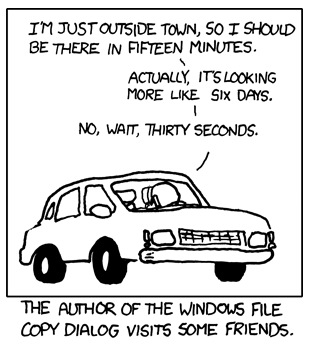
Saw this while I was downloading.
Relaxed and Paying Attention
I thought I was going to keep this blog updated with my progress on editing and understanding the work I recently made in central Asia. I will post some related remarks over at Asia Central after I get finished here. My issue is that the rest of the World is spinning with such coruscation that I’m caught simply looking. Now, there are worse things to get caught looking at than blogs and Facebook. For instance, Twitter seems like a real squander of our precious time. So, here are a few links and excerpts from my various emails from the past couple of days.
I’ll start with a quote that Jack Kelleher sent me in an email this morning:
Renowned guitarist Keith Richards of the Rolling Stones, when asked what he did with all the money he earned throughout his incredible career, replied: “I spent 80 per cent of it on booze, women and drugs.” When asked what he did with the other 20 per cent, he responded: “I wasted it.”

Scarface by Christopher Lizon
Chris Lizon sent me this Scarface car hood. It’s one of about 500 great pictures he has taken this summer.
Another friend, John Sevigny, sent me this provocative link to the article he wrote about Caravaggio’s Taking of Christ.

John also has a blog, Gone City, that he uses as a platform to rant and rave. He trashes Annie Liebovitz and George Wallace in recent posts. Here’s a still life photograph by John.
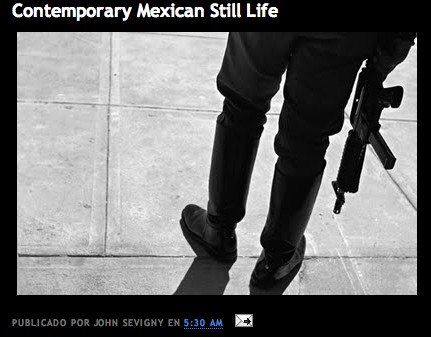
My wife, Vivian Leskes, sent me this link from the New York Times about some famous faked photographs.

Check out the NYT”s excellent Fake slide show.
Steve Bisson, a guy I didn’t know, sent me an email this morning with links to his Urbanautica website and his Facebook page. He’s got a great eye and he’s a damn good designer. Both these links are loaded with strong portfolios, like Dubailand by Aleix Plademunt.

Dubailand by Aleix Plademunt
Still Coruscating

Yes, I’m here and ready to blog. First, I apologize for the long hiatus. I have a three week excuse because my internet satellite dish was down, but that still leaves two weeks in which I also had nothing to post. I’ll call that summer vacation. It is almost time to bring the “all about Frank” cycle to an end and bring the “photo teacher” phase of the blog back into action. I do have a month before I’m back to teaching so I will indulge the “all about me” energy for a few more posts.
Since Vivian and I returned from Central Asia 5 weeks ago, I have been editing my new pictures between cutting and hauling wood. My progress has been slow on both fronts. I still have several logs to drag out of the woods and I still need to discern the themes of all the pictures I’ve made. Understanding the why and whatever of my own work is a challenge. Many documentary photographers begin with a thesis and work to illustrate their project. Whether or not they succeed is irrelevant to having a good project description. Photojournalists investigate issues or take on assignments. They mostly rely on others to figure out the written text. I don’t readily fit into either mold. Sometimes I do photojournalistic types of assignments, but mostly I just see pictures. When I have a camera with me, I make them. I used to draw parameters and attempt to work within my self-created constraints. Those boxes and bags that I would creatively try to fight my way out of have consistently expanded to the size of countries and continents. My approach to photographing the world is one of openness with fewer limits or labels. When I’m “relaxed and paying attention” good things happen.
Oh, oh, I’m blogging toward the category of “photo teacher.” That’s for next month. For now, I’ll shut-up and post-up some pictures. These photos are from Dushambe, Tajikistan.

The square where Lenin used to stand.
I have a pile of pictures from the Tajikistan Pamirs that I’ll upload to my Asia Central blog. Enjoy.
Security Issues
Vivian and I flew in from Russia Sunday night. We spent Monday counting our blessings. Now is the time to debrief and to appreciate our safe return to Ashfield. Here is a picture that was on my flash drive.

The Chess Move
This night chess match from Elista was also posted on Asia Central, the blog that I started while in Uzbekistan where WordPress is banned and blocked. I figure that WordPress must be doing something right (because their software is easier to use than Blogger), so I am back on The Coruscating Camera ever since we got out of Uzbekistan.

Busted for photographing tanks in the park.
Uzbekistan is great if you don’t run afoul of issues of national importance. I had several incidents where I was stopped by police for various questionable reasons. I tried to photograph old tanks that were cemented into the ground in a public park in Tashkent. These officers accused me of breaching national security. After checking my papers, the police made me delete all the pictures that I took of their WWII weaponry. There’s more on the perils of tank photography at the end of this post.
The day after my embarrassing breach of tank etiquette, I was stopped for illegally photographing in a subway station, except that I wasn’t in a subway station. I was in a pedestrian crossing tunnel trying to get from one side of the street to another.

The guilty picture.
A subway entrance happened to be off of that tunnel. Anyway, the Uzbek’s have a beautiful subway system that they should be proud of.
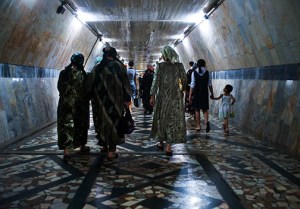
The Tashkent Subway
I previously blogged about the driver who got dragged away while we were in his taxi. I hope he got out of that jam. Remember the most famous picture about human rights in China? You know, the one of the guy standing in front of that tank in Tiannaman Square. I saw all kinds of press about that picture recently, but only scant mention of the brave soul who created that rare, world consciousness raising moment. Various blogs were congratulating the many photographers who took the picture while there was no mention of what happened to that guy who was dragged off by Chinese police. What ever happened to that true hero?
Surveillance and harassment isn’t just an Uzbek thing. As we were driving out of the Pamirs in Tajikistan there were road blocks every 10 or 15 kilometers.

Checkpoint
An Iranian passenger in our 4-wheel drive vehicle was being detained for 10 or 15 minutes at a checkpoint when, finally, one of our Tajik passengers said that she would take care of it. She went into the checkpoint shack and came out with the Iranian. It cost her 40 or 50 cents to pay off the guards. Hell, anyone can get detained, anywhere, at any time, in any country. It’s nice to know that there are a few places where 50 cents can buy more than a cup of coffee. Oh,shite, 50 cents can’t even buy a cup of coffee.
I have empathy for the guards who are ordered to do their unenviable jobs. I was watching these security people at a soccer game in Uzbekistan. They were as interested in me as I was in them.

Giving me "the look"

Radio Contact

Security Patrol

On the job

Stadium Video
It turns out that I wasn’t the only “person of interest” at the soccer game. This guy was systematically recording everyone in the audience of around 10,000 fans. Too bad they simply didn’t have 100 or so cameras nailed to the tops of poles like they would have in any other decently paranoid country- like the USA.
I’m posting a picture of this kid who was wandering the streets in Tashkent because he reminds me of the cover photo off an old Bob Dylan album.

Nashville Skyline anyone?

Roof Dog Harassment
My answer to the World’s security issues is Roof Dogs. They work almost successfully in Mexico and dozens of other countries. The basic idea is that they bark all night and keep everyone awake. Therefore, no one is needed for low paying security patrols because everyone is vigilant and miserable.
I love the way that traveling reveals the answers to all of civilization’s nagging problems.
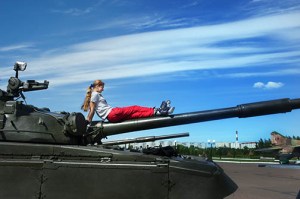
Learning to live with tanks
For instance, the next time you see a tank in a park, just climb on up (with rollerblades and all) and relax. There is no law saying that you can’t have a good time with a tank. You just can’t photograph one.
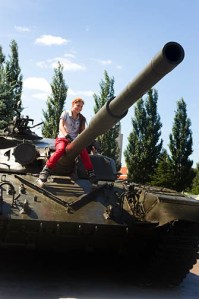
Good excuse to photograph tanks.
Or, maybe, you can photograph your girlfriend who just happens to be straddling a tank. In Russia I saw girls straddling tanks all the time.
Elista Hurrah!

Night Chess at the Central Pagoda
I wanted to do a post all about chess in Elista, but I really don’t know much about chess in Elista. They do have Chess City.
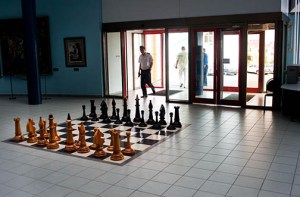
Central Hall of Chess City
And they have a Chess Hotel for visiting champions.

Chess suite at the Elista Hotel
Chess only got us so far in Elista,. We were more interested in the Buddhist culture of Kalmykia.

Tree of Prayer Flags
My favorite moment was when the girl on roller blades started spinning the prayer wheel in the central pagoda.

Buddha FanGirl Generates Dharma Energy
To me this is Checkmate. The Buddha wins.
Cozy in Kalmykia
It is so nice to get to a Buddhist culture. Not that the other cultures were not good. There’s just something heartwarming about seeing billboards of the Dalai Lama and the Karmapa along the roads, and having the center of town be a giant pagoda with a prayer wheel inside. I’ll start with some pictures from our day in Moscow. and then dive into Elista.

Moscow Arm

Fallen Hero
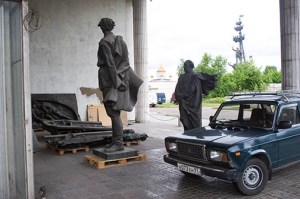
The Wait
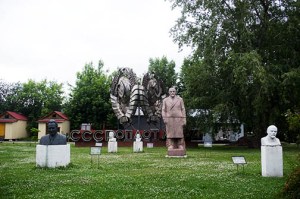
Heads of State
From a visual celebration of Russia’s Soviet past to a realistic reminder of standard Soviet precedure. This is a monument in Elista recalling 1946, when Staln gave the Kalmyks two hours notice to board boxcars and be shipped to Siberia for over 10 years. 

At the Airport, Elista
So, we go from Soviet irrationalism to regional nationalism. At this point of the cultural survival impulse it is great to see everyone trying to figure out who they are and where they came from.

Buddhist Billboard

His Holiness the Dalai Lama
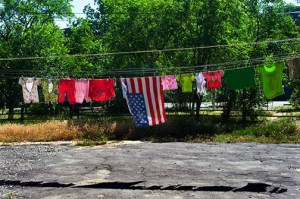
Americans are well-liked in Kalmykia

Elena shows us our room
We stayed in this wild “chess” hotel for our first night. I’ll do a chess post later as it is their national pastime. Elena is one of a team of wonderful English language professionals who have been taking very good care of us. Tomorrow she says she’ll take us to the tank monument.

Water pipe jumping
Vivian has been giving workshops every day. Sometimes I hang out at the school. These kids are jumping over the above ground hot water pipes that run all through Russia and the FSU.

Desk and Chairs
This was sitting in the school corridor.

Gayla in the playground
One day I did a mini photo workshop with some of the students. We climbed all over campus.

Sacha, Galya and the waterpipes
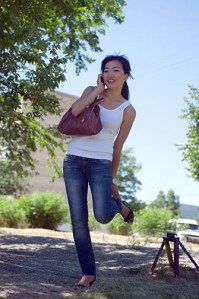
Sacha gets a phone call

Students at camp
I’m out of internet time so I’ll add to this later.
Back on WordPress
I had problems with blogging in Tajikistan, then, when I got to Uzbekistan a couple of weeks ago WordPress was totally blocked. The government banned the site. I apologize for yet another truncated message. I switched my blog to
https://fmward.wordpress.com
Please take a look at my many posts from Uzbekistan.
I’ll post more to The Coruscating Camera as soon as I get settled in Kalmykia. Vivian and I fly there tomorrow. For today we are going to museums and relaxing in a fancy hotel in Moscow. It’s so fancy that they charge $10 an hour for internet. That’s all for now.
Last Day in Tajikstan
I’m loving Khujand. It has the best market in Central Asia as far as good people to photograph and good stuff to look at.
This broke down internet cafe won’t let me post so I apologize and will try to get something up later.
The Anniversary Post
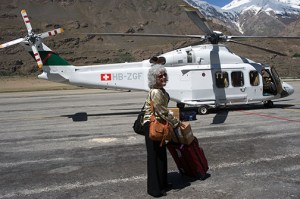
Vivian from the Tarmac
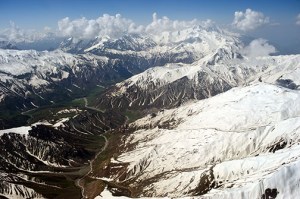
- Pamirs from Above
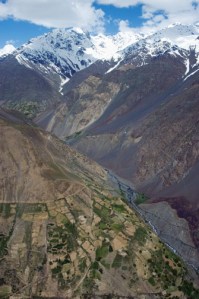
Khorog from Above

Vivian and Students and Gulya
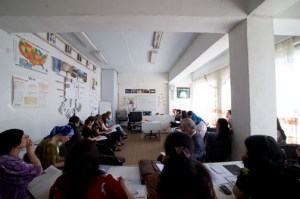
Today is our 31st anniversary. Vivian taught classes while I wandered around Dushanbe. Above is actually a picture of her classroom in Khorog.
In Dushanbe, a huge rainfall filled the open sewers and even backed-up to the point that at the central intersection, in front of my favorite coffee spot, water started spurting forth from underground and out the large sewer vents. It was a glorious sight in a terrible sort of way.
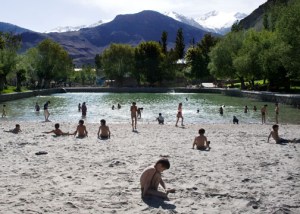
Central Park Beach
Back to Khorog, there is a stone pool filled with diverted river water in Central Park downtown.

Khorog Market
Vivian and I have spent the last several days eating mostly bread and water. Well, water as the main ingredient of soup with ripped pieces of this delicious bread floating around in it.
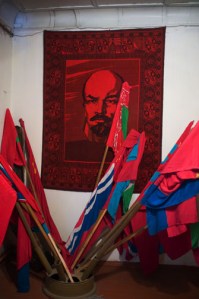
Lenin and His Flags
Gulya and I spent a fun hour in the Khorog museum. Gulya was our minder in the Pamirs and she is coming with us on the plane to Khujand tomorrow morning. In the FSU, one’s host often supplies one with a minder. In this case, the host is the American Embassy and the minder is not in the usual post-communist mold. Vivian asked me not to flirt with her and seeing it is our anniversary, I’ll behave.
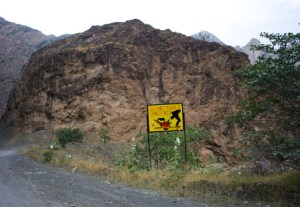
Mine Field Warning
In the former Soviet Union, one should take heed that there could be danger at any step. Above is one of the warning signs of minefields that dot the Tajik/Afghan border. Below is a sign from a distance with an Afghan sentry house across the Panj River from where we were driving back from the Pamirs.
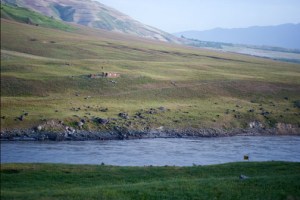
Minefield
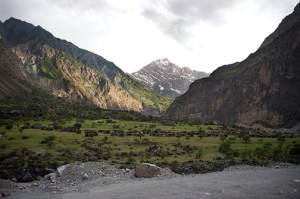
Afghan Village
Tomorrow we go to Khujand, a 2500 year old city that is not supposed to be beautiful. Beautiful cities are not my specialty so I am looking forward to a visit while Vivian spends a couple of days giving seminars. I feel like Guy Delisle, the guy who writes those fabulous graphic travel stories while his wife works for Doctors Without Borders. I’ve got to refine my storytelling arc a bit, but I’m working on it. Next post I’ll try not to mix and match words and pictures.
Border Patrol
We got back to our hotel in Dushanbe at 2 AM this morning after 15 grueling hours of overland transport from Khorog, the provincial capital of the Pamirs. We traveled along the Panj river for 10 of those 15 hours and my view out the window was into Afghanistan. It was an eye opener on several levels.
Skip the next paragraph as I am ranting about Central Asian political realities.
In an earlier post I said that Tajikistan is what Afghanistan would possibly be like if Afghanistan had not spent the past 30 plus years at war. Well, I neglected to mention that Tajikistan spent about 5 years in the mid 1990’s in a deadly civil war. The opposing factions of a basically tribal conflict were killing each other based on which identity cards each were carrying. The guys in the Pamirs backed the losing side of the war and have been suffering for it for the past 12 years. They have very little in terms of civil support and are likely to continue to be the last place to receive government subsidies.
Now, back to the road. Road? 15 hours of driving along rock (or collapsing mud) precipices, under waterfalls (seems to me I had already done that at Disney World), through rushing streams (one with several feet of white water), zig-zagging around rock slides (sometimes through boulder strewn fields) and barely avoiding 100 foot sink holes (I hate those guys). Let me clarify the severity of this forced excursion (the weather was too bad for the little plane to fly us out) by saying that it was no worse, and not less beautiful, than the Tibetan plateau in monsoon and driving from Lhasa to Katmandu over several days. The problem was the bone crushing 15 hour length of the ride. I could talk about toilets and time spans here, but I’ll spare you the details and get right to the point.
You may not be interested in the “point” so skip the next 2 paragraphs, also.
The Pamirs/Tajikistan = Afghanistan + Pakistan divided by foreign aid dollars minus the US military incursions. (Sorry, I ran out of math symbols on my laptop.) If you can’t follow my Bushian fuzzy math, I’m saying that, like Afghanistan and northern Pakistan, the Pamirs is a sorry mess with basically good people who harbor resentments from past histories, but do well with support from outside countries. In Tajikistan’s case, the Soviets, relatively peacefully, took over the country and propped it up for 50 or more years. The Soviets tried to do the same for Afghanistan in the 80s and Afghanistan’s US supported pre-Taliban warlord resistance may have contributed to the fall of the USSR. US military support in Afghanistan in the 80s certainly assisted the current day’s problems for Afghanistan and the US.
Now that the USSR no longer exists, Tajikistan is left without an economic sponsor. It is literally falling apart one road at a time. It has no exports and has only recently managed to feed itself mostly on home grown products. True support is not a matter or cheering on a young democracy, or in the US approach to the region, inserting a military presence. It’s about concrete financial aid that does not simply line the oligarchy’s pockets. I think that in the long run, sending earth moving equipment and helping with food development strategies can open up the region’s resources for future economic security. This is not a one year, one US administration fix. It may take 20 or 30 years and orchestrated support with other countries, but it is better than McCain’s suggestion last year of an endless war.
OK, so where are the pictures? I just wanted to separate some text from pictures because some of you do not have a fast internet connection. I’ll post small pictures so people like my sister and my neighbors don’t have to wait for the images to load. I know that my sister doesn’t want to read the above rant so I guess this approach is one of planned obsolescence. I promise that the next post will come with pictures and minimal bull.
Afghan Market Day
We arrived at the Tajik/Afghan border around 8 this morning. I was surprised that the action hadn’t really started yet. Once a week Afghans and Tajiks meet in a walled-in area adjacent to the bridge connecting the two countries. Afghans are welcome, for a 20 cent price, to cross the bridge and enter into a free trade, limited access zone to sell whatever they have (that’s legal) and buy food and whatever they can get from the Tajik traders. As I suspected, it was mostly an Afghan scene with the graceful and obstinate Afghans taking advantage of the Tajiks who usually don’t have access to such a black market abundanced of ridiculously cheap make-up, soap and tinkets.
I am a bit surprised by the make-up, but these are not the Taliban. In fact, most of the young men are clean shaven to protest the fundamentalist Moslems. Most are in traditional dress, but that’s in support of their great culture.
The Afghan soldiers all have new uniforms. They even had empty Leatherman knife cases on their belts. I hope they weren’t simply given empty cases. Maybe they had to deposit their knives at the Afghan entryway.
I bought a great Arafat white and black shawl to tuck into my leather sports coat. I’m on a campaign to look more like a typical Tajik male, but most likely I just look like an American idiot. I need those pointy black leather shoes to really pull off the look.
We fly out of the Pamirs tomorrow in a very suspicious looking little plane. The helicopter ride was a transformative introduction to a part of the world I’d only dreamed of. The return flight will be a trip back to Dushanbe and some creature comforts like coffee, food and toilets. It’s a trade off that I think I’m ready for.
The High Pamirs (and some lows)
Yesterday, I was on the clock and didn’t really write much of an informative post. Today, I have a few minutes and a few things to say. Vivian and I were in Afghanistan in 1978 (I was also there in 1973) for our honeymoon. I love the idea of honeymnoon in Afghanistan. I think that is why we don’t fight much. If I was getting married today, I’d still pick Afghanistan for a honeymoon. That way we’d quickly learn that fighting leads to nowhere. I’m thinking of such things because June 1st is our anniverary.
I’m also thinking that Khorog (the large village we are staying in) is what Afghanistan would be like without the 30 plus years of war they have seen since our last trip to the region. This Tajik/Pamiri/Afghan society on the isolated (and not possible to regulate) border with Afghanistan is not a beautiful town, but it is in a spectacular location. The buildings are mostly Soviet boxes with nothing to recommend them but the people inside. The Khorog University, where Vivian is leading seminars, has 5000 students and one set of toilets. Vivian was visited by Montezuma’s revenge while teaching yesterday and nearly passed-out by simply being in the ladies area. She had to cancel her class. Word got out and somebody actualy hosed down the area so it no longer spread smells throughout the cafeteria and two floors of classrooms. I checked it out a few minutes ago. I was very impressed walking through the cafeteria. Incidently, I had half and half borscht from there yesterday. I had it as take out because I would have passed out if I ate it in their dining room. It was half food and half grease, so I almost passed out eating it at the hotel. Anyway, they did their best to clean up the place and I could even stand in a room next to the dreaded area and make a picture of their fire fighting apparatus hanging on the wall.
So, it’s the same old story– beautiful people, beautiful landscape, relatively photographable decaying buildings and real bad toilets. The technique for having a great experience here is to enjoy the comraderie of new friends and colleagues (these ladies are smart, funny, non-alcoholic, dress like Afghan princesses and are taking great care of us), appreciate the thin clear air (my altitude headache subsided after two days), spend some time looking at mountains and rivers (walking foot bridges and riding around in mini-mini six passenger vans known as tangiams), and taking pictures of as many things as I want to see photographed.
My plans to photograph singular subjects in the vast emptiness of montains and valleys has gone out the window because there are no people out alone in those isolated areas. People stick together. Boys walk arm and arm with boys and men touch cheeks when they greet each other. When people see me they touch their heart with their right hand in a sufi greeting. This is a great place to be. Simply avoid any activity that may lead to toilet usage.
The Shadows in Between
Traveling without a laptop has its difficulties. Damn, can you believe that I’m on a computer that types Arabic letters in Farsi (at an internet cafe), in a region that speaks Pamiri (which is not a written language), in a country that speaks Tajik (which is in cyrilic script), with a translator that speaks Russian(my wife- no complaints). I’m meeting people who speak five languages fluently (including German, Russian, English, and who have never been out of the village of Khorog, even to visit the capital city of Dushanbe)…
AND I’m saying that traveling without my laptop is a pain in the ass because I had to lighten up to fly on Aga Khan’s helicopter (which was a most magnificent trip through 20,000 foot peaks, as if I was in an episode of Planet Earth).
Americans are jerks (self included), and yet, people like Americans because our president is a Moslem. So I’m not complaining. I think I’ll make it without the ability to upload pictures for a few more days. I have got a few good ones that I want to share.
Off to the Pamirs
Here’s a quick look at some Dushanbe action. It is a quiet town, but the young folks have their plans. I’ve only seen one couple holding hands in public. They were embarrassed when they saw me take a picture. Unlike Russia, Moslem Dushanbe is strictly legit.
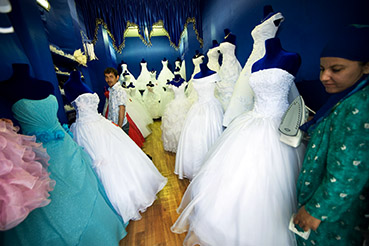 More from Dushanbe later. Tomorrow, it’s the Pamirs.
 The Coruscating Camera